Skip to content
Preview
Members Only Science Complete Lesson Pack Grade 3 (Year 4)
No ratings yet

Yes or No? Using and Making Classification Keys

About This Resource

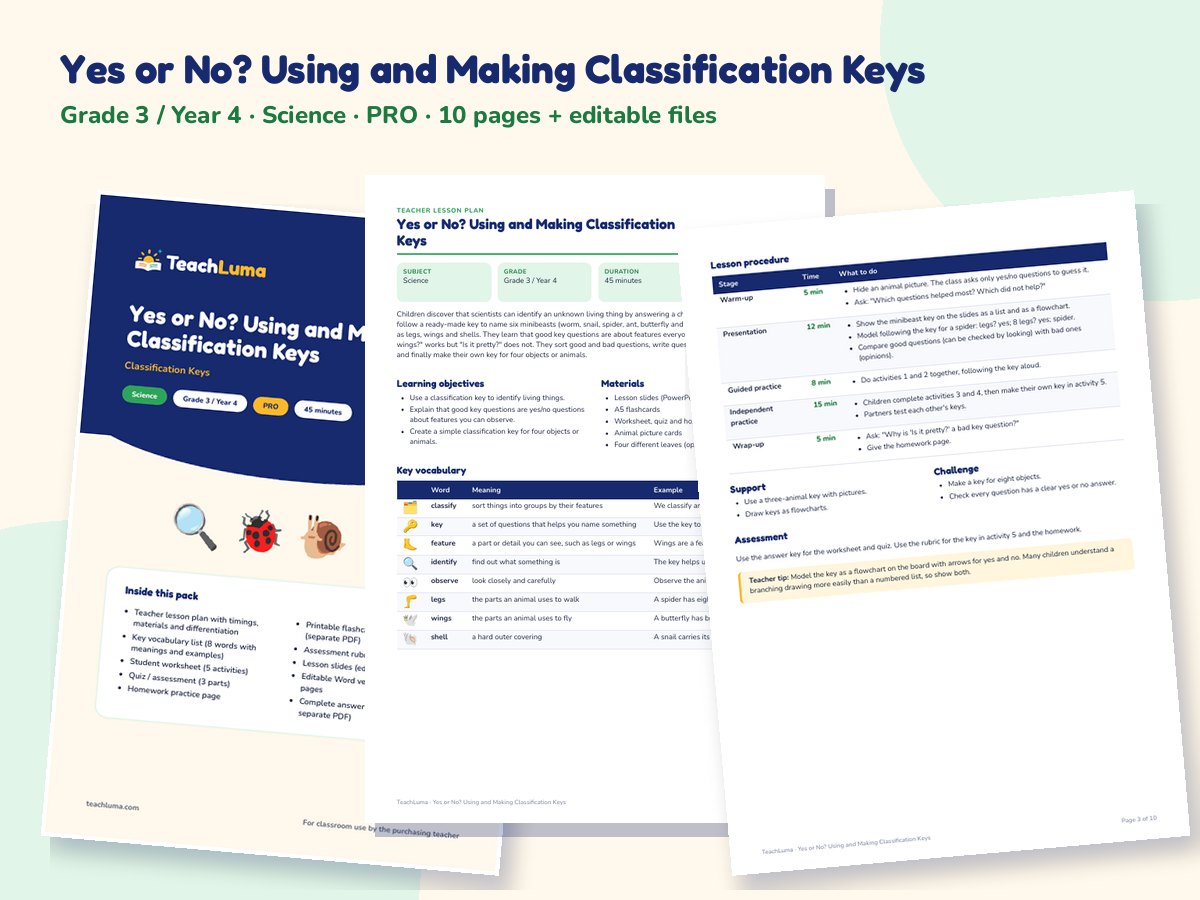
A complete Grade 3 science pack on classification keys: how scientists use a series of yes/no questions to sort and identify living things, how to follow a key step by step to name a minibeast, what makes a good key question (one you can check by looking, not an opinion), and how to build a simple key of your own. Includes a lesson plan, worksheet, quiz, homework, A5 flashcards, a rubric, slides with speaker notes, Word files and answer keys.

Overview

Children discover that scientists can identify an unknown living thing by answering a chain of yes/no questions. They follow a ready-made key to name six minibeasts (worm, snail, spider, ant, butterfly and beetle), checking features such as legs, wings and shells. They learn that good key questions are about features everyone can observe, so "Does it have wings?" works but "Is it pretty?" does not. They sort good and bad questions, write questions that split pairs of animals, and finally make their own key for four objects or animals.

Resource Details

Subject
Science
Topic
Classification Keys
Category
Living Things
File Type
PDF
File Size
346.9 KB
Published
08 Nov 2026
Downloads
0

Members Only

Upgrade to Teacher Pro (from ฿199/month) to download this resource.

Share:

Looking for something different? Request a Resource.

Grade 3 (ages 8–9) 45 minutes Life science classifying observing asking questions logical thinking

Learning Objectives

  • Use a classification key to identify living things.
  • Explain that good key questions are yes/no questions about features you can observe.
  • Create a simple classification key for four objects or animals.

How to Use This Resource

  • Play twenty questions with an animal picture: the class may only ask yes/no questions. Ask: "Which questions helped most?"
  • Teach how to follow a key with the slides, then do worksheet activities 1 and 2 together.
  • Children complete activities 3 to 5 and make their own key, then use the quiz and send the homework page home.

Classroom Activity Ideas

  • Key of the class: make a key that separates four volunteers using questions such as "Are you wearing glasses?"
  • Leaf key: collect four different leaves and build a key based on shape, edges and size.
  • Swap and test: children swap keys with a partner and check whether the partner can identify every object.

Differentiation

Support: give a key with only three animals and pictures beside each question. Challenge: make a key for eight objects and check that every question has a clear yes or no answer.

Assessment

Use the worksheet and quiz to check following a key and judging questions. Use the rubric for the key children make in activity 5 and the homework.

Teacher Tips

Model the key as a flowchart on the board with arrows for yes and no. Many children understand a branching drawing more easily than a numbered list, so show both.

What's Included

  • 10-page printable PDF lesson pack: teacher lesson plan with timings, materials and differentiation
  • Key vocabulary list (8 words with meanings and examples)
  • Student worksheet (5 activities)
  • Quiz / assessment (3 parts)
  • Homework practice page
  • Printable flashcards: 8 A5 picture cards (separate PDF)
  • Assessment rubric (4 levels)
  • Lesson slides (editable PowerPoint)
  • Editable Word version of all student pages
  • Complete answer key (also as a separate PDF)

Additional Files

  • Lesson Slides (PPTX)
  • Editable Student Pages and Lesson Plan (DOCX)
  • A5 Flashcards (PDF)
  • Answer Key (PDF)

Teacher Reviews

No ratings yet

Be the first teacher to review this resource.

Sign in to review this resource.

Related Resources

Advertisement