Skip to content
Preview
Members Only Science Complete Lesson Pack Grade 6 (Year 7)
No ratings yet

Festive Lights: Series and Parallel Circuits

About This Resource

A complete Grade 6 science pack on series and parallel circuits with a festive lights theme. Students compare one-path and branching circuits, predict what happens when a bulb is removed or more bulbs are added, place switches to control parts of a circuit and explain why homes are wired in parallel. Includes slides, a lesson plan, worksheet, quiz, homework, flashcards, a rubric and answer keys.

Overview

Why does a whole string of lights sometimes go dark when one bulb is loose? Students investigate two ways of connecting bulbs. In a series circuit, there is only one path for the current, so removing one bulb breaks the circuit and every bulb goes out; adding more bulbs in series makes each one dimmer. In a parallel circuit, each bulb is on its own branch, so the other bulbs stay lit when one is removed, and each bulb stays bright. Students build both circuits with cells, bulbs and switches, record their observations, decide where to place a switch to control one bulb or all of them and explain why the lights in a home are wired in parallel.

Resource Details

Subject
Science
Topic
Festive Lights: Series and Parallel Circuits
Category
Forces & Energy
File Type
PDF
File Size
321.7 KB
Published
11 Nov 2026
Downloads
0

Members Only

Upgrade to Teacher Pro (from ฿199/month) to download this resource.

Share:

Looking for something different? Request a Resource.

Grade 6 science (ages 11–12) 60 minutes Physical science electricity predicting observing explaining

Learning Objectives

  • Describe the difference between series and parallel circuits.
  • Predict how removing or adding bulbs affects series and parallel circuits.
  • Explain where to place a switch to control all or part of a circuit.

How to Use This Resource

  • Start with the slides: ask why a whole string of lights might go dark when one bulb is loose.
  • Build a series circuit and a parallel circuit, then do worksheet activities 1 and 2 together.
  • Students complete activities 3 to 6, then use the quiz and send the homework page home.

Classroom Activity Ideas

  • Circuit challenge: groups build a series circuit with two bulbs, then rebuild it as a parallel circuit and compare the brightness.
  • Remove a bulb: unscrew one bulb in each circuit and record what happens to the others.
  • Switch puzzle: students design a circuit in which one switch controls both bulbs and another switch controls only one bulb.

Differentiation

Support: give students a labeled photo of each circuit to copy and sentence starters for explanations. Challenge: students predict and test circuits with three bulbs and explain why a parallel circuit drains the battery faster.

Assessment

Use the worksheet and quiz to check understanding of series and parallel circuits. Use the rubric to assess the homework circuit design and explanation.

Teacher Tips

Use only cells and batteries for investigations, and remind students that mains electricity at home is never safe to experiment with. If bulbs do not light, check that each connection is tight and that the cells are not flat. Not all students celebrate festivals with lights, so the same circuits can be described as lights for any celebration, a shop window or a bicycle.

What's Included

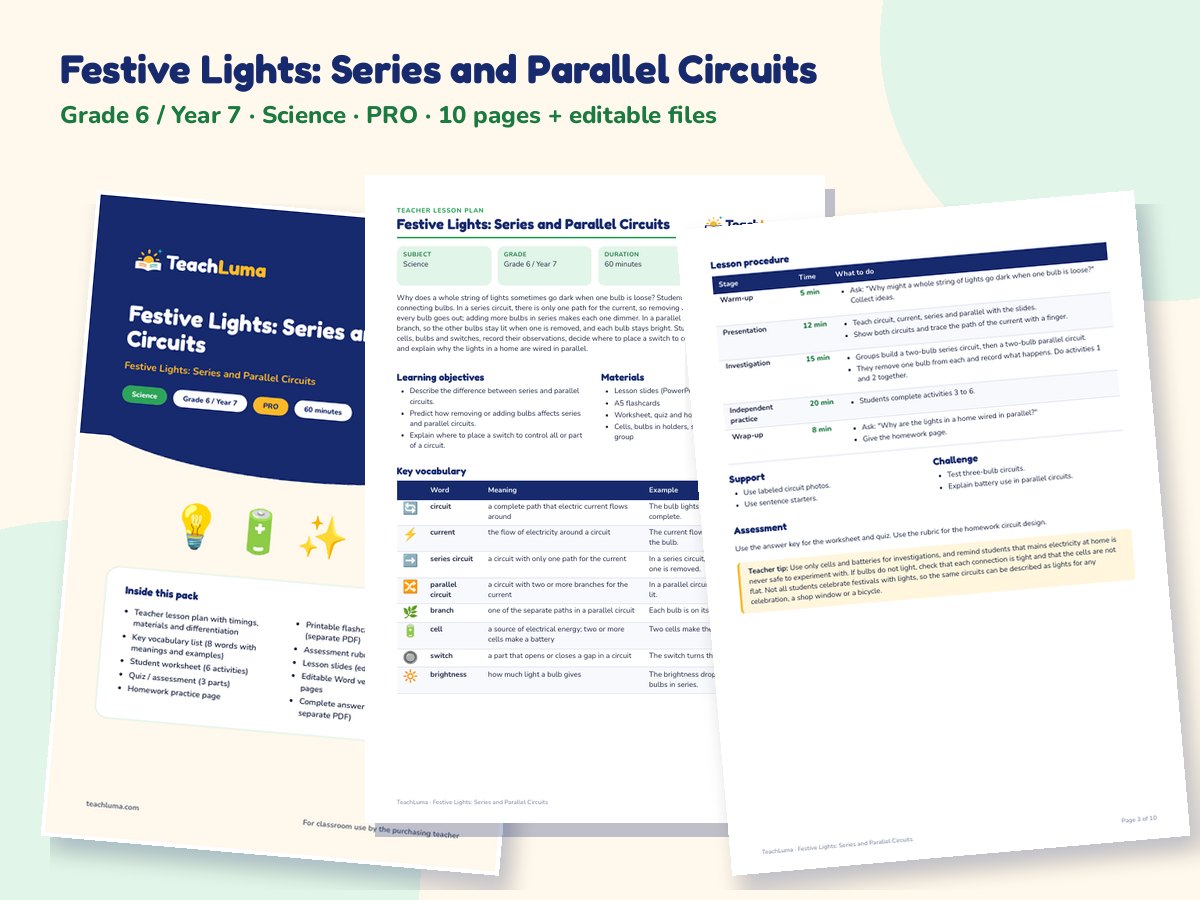
  • 10-page printable PDF lesson pack: teacher lesson plan with timings, materials and differentiation
  • Key vocabulary list (8 words with meanings and examples)
  • Student worksheet (6 activities)
  • Quiz / assessment (3 parts)
  • Homework practice page
  • Printable flashcards: 8 A5 picture cards (separate PDF)
  • Assessment rubric (4 levels)
  • Lesson slides (editable PowerPoint)
  • Editable Word version of all student pages
  • Complete answer key (also as a separate PDF)

Additional Files

  • Lesson Slides (PPTX)
  • Editable Student Pages and Lesson Plan (DOCX)
  • A5 Flashcards (PDF)
  • Answer Key (PDF)

Teacher Reviews

No ratings yet

Be the first teacher to review this resource.

Sign in to review this resource.

Related Resources

Advertisement