Skip to content
Preview
Free Science Worksheet Grade 6
No ratings yet

Stored and Moving: Kinetic and Potential Energy

About This Resource

A free Grade 6 science worksheet pack on kinetic and potential energy: energy of motion and stored energy, how mass and speed affect kinetic energy, how height and mass affect gravitational potential energy, elastic and chemical potential energy, energy transformations on a roller coaster and a pendulum, and the law of conservation of energy. Includes a timed lesson plan, a six-activity worksheet with a reading text, an editable Word version and answer key.

Overview

Students learn that kinetic energy is the energy of a moving object and potential energy is stored energy that can be released later. They explore how a heavier or faster object has more kinetic energy, and how a higher or heavier object has more gravitational potential energy. They identify elastic (a stretched rubber band) and chemical (food, batteries) potential energy, read about energy changing back and forth on a roller coaster, analyze a ball dropped from different heights and explain how energy changes form but is never created or destroyed.

Resource Details

Subject
Science
Topic
Kinetic and Potential Energy
Category
Forces & Energy
File Type
PDF
File Size
266.6 KB
Published
01 Nov 2026
Downloads
0
Download

Free download — no account required.

Teaching this in class? Try our free Random Name Picker & Timer.

Share:

Looking for something different? Request a Resource.

Grade 6 (ages 11–12) 50 minutes Physical science analyzing data reading comprehension explaining predicting

Student Task

  • Start with a demonstration: hold a ball still above the desk, then drop it. Ask when it had stored energy and when it had energy of motion.
  • Teach kinetic and potential energy, the factors that change each one and energy transformations, then do activities 1 and 2 together.
  • Students read the text and complete activities 3 to 6. Answers are in the answer key.

Classroom Use

  • Ramp race: roll a toy car down a ramp from three heights and measure how far it travels across the floor.
  • Pendulum swing: tie a washer to a string and mark where it moves fastest and where it stops for a moment.
  • Rubber band launch: stretch a rubber band different amounts and measure how far it flies, linking more stretch to more stored energy.

Differentiation

Support: give a two-column chart (kinetic | potential) with picture examples and a word bank, and read the text aloud. Challenge: explain why a bouncing ball never returns to its starting height (some energy changes to sound and heat) and design a ramp test with one variable changed.

Answer Key & Assessment

Activities 1 to 5 check definitions, factors and energy transformations (answer key included). Activity 6 checks explaining energy changes with scientific vocabulary.

Learning Objectives

  • Define kinetic and potential energy and give examples of each.
  • Explain how mass and speed affect kinetic energy, and how mass and height affect gravitational potential energy.
  • Describe energy transformations between potential and kinetic energy and state the law of conservation of energy.

Teacher Tips

Use the same ball all lesson. Hold it still (all potential), drop it (potential changing to kinetic), and catch it just before the floor (mostly kinetic). Ask students to point up for potential and sideways for kinetic at each moment to keep them actively thinking.

What's Included

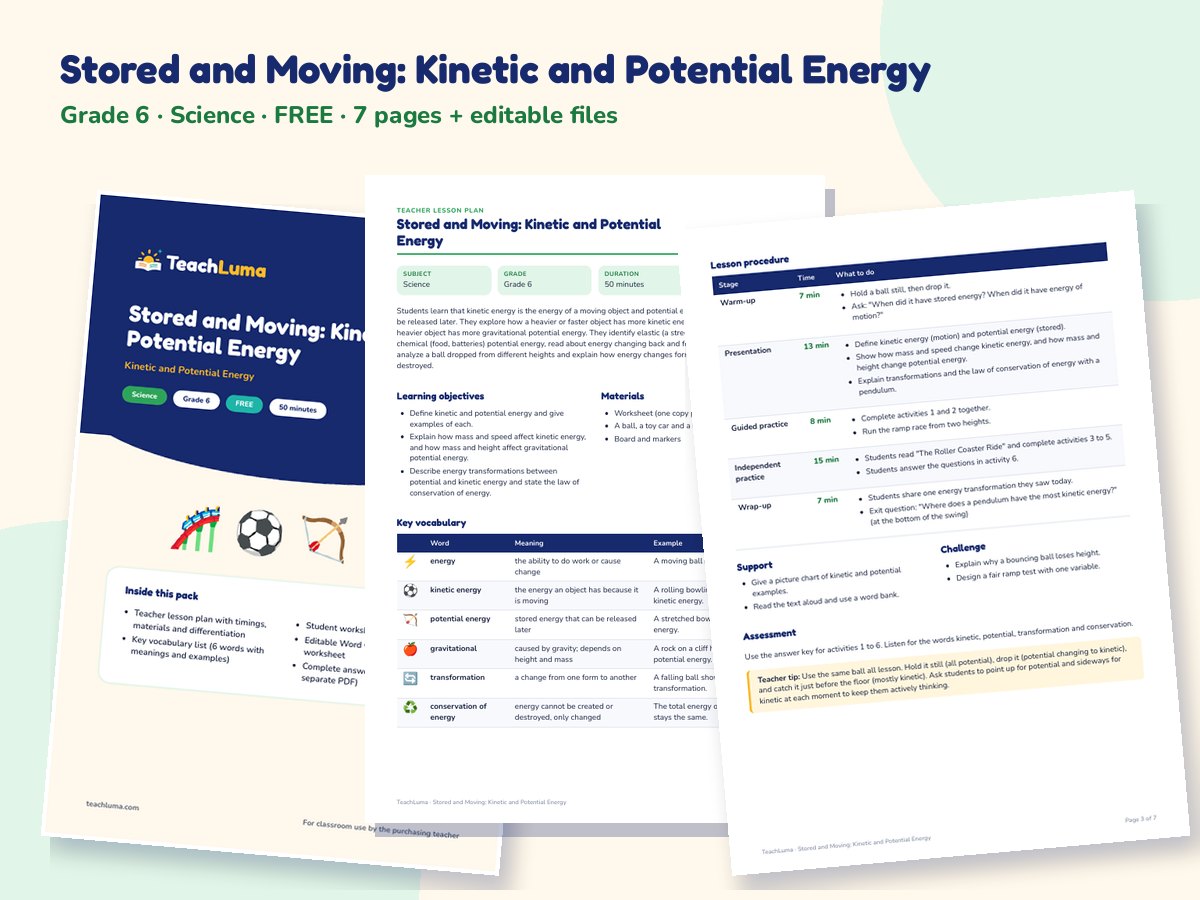
  • 7-page printable PDF lesson pack: teacher lesson plan with timings, materials and differentiation
  • Key vocabulary list (6 words with meanings and examples)
  • Student worksheet (6 activities)
  • Editable Word version of the worksheet
  • Complete answer key (also as a separate PDF)

Additional Files


Teacher Reviews

No ratings yet

Be the first teacher to review this resource.

Sign in to review this resource.

Related Resources

Advertisement