Skip to content
Preview
Members Only Science Complete Lesson Pack Grade 6 (Year 7)
No ratings yet

On the Move: Heat Transfer by Conduction, Convection and Radiation

About This Resource

A complete Grade 6 science lesson pack on heat transfer: the difference between heat and temperature, heat always moving from hotter to cooler, conduction through solids, convection currents in liquids and gases, radiation from the Sun and fires, thermal conductors and insulators, and how a vacuum flask and a house reduce heat transfer. Includes slides, a timed lesson plan, flashcards, worksheet, quiz, homework, rubric and answer key.

Overview

Students learn that heat is energy that moves from a hotter object to a cooler one until they reach the same temperature. They study the three ways heat moves: conduction (through direct contact, especially in metals), convection (warm liquids and gases rise and cool ones sink, forming currents) and radiation (heat that travels as invisible waves, even through empty space). They classify everyday examples, compare thermal conductors and insulators, read about how a vacuum flask blocks all three types of transfer and interpret data from a cooling experiment comparing cups made of different materials.

Resource Details

Subject
Science
Topic
Heat Transfer
Category
Forces & Energy
File Type
PDF
File Size
347.9 KB
Published
04 Nov 2026
Downloads
0

Members Only

Upgrade to Teacher Pro (from ฿199/month) to download this resource.

Share:

Looking for something different? Request a Resource.

Grade 6 (ages 11–12) 55 minutes Physical science classifying reading data fair testing explaining

Learning Objectives

  • Explain that heat moves from hotter to cooler objects until they reach the same temperature.
  • Describe and give examples of conduction, convection and radiation.
  • Compare thermal conductors and insulators and use data to evaluate which materials reduce heat transfer.

How to Use This Resource

  • Start with slide 1: a metal spoon and a wooden spoon sit in hot soup. Ask, "Which handle gets hot? Why?"
  • Teach heat flow, conduction, convection and radiation with the slides and demonstrations, then do activities 1 and 2 together.
  • Students complete activities 3 to 6, then use the quiz to check and the homework design task. Answers are in the answer key.

Classroom Activity Ideas

  • Butter race: stick beads to metal, plastic and wooden spoons with butter, stand them in hot water and see which bead drops first.
  • Convection in a cup: put a drop of food coloring in a cup of hot water and a cup of cold water and compare how it moves.
  • Keep it cold: groups wrap ice cubes in different materials and record which lasts longest.

Differentiation

Support: give a picture chart of the three types of heat transfer and a word bank. Challenge: explain how a vacuum flask reduces all three types of heat transfer and design a lunch box that keeps food warm.

Assessment

Worksheet activities and the quiz check heat flow, the three types of transfer, conductors and insulators, and reading data (answer key included). Explanations and the homework design are checked with the rubric.

Teacher Tips

Many students say that cold moves into things. Correct this gently: only heat moves, always from hot to cold. An ice cube feels cold because heat flows from your hand into the ice. Use hot water carefully and let only the teacher handle it.

What's Included

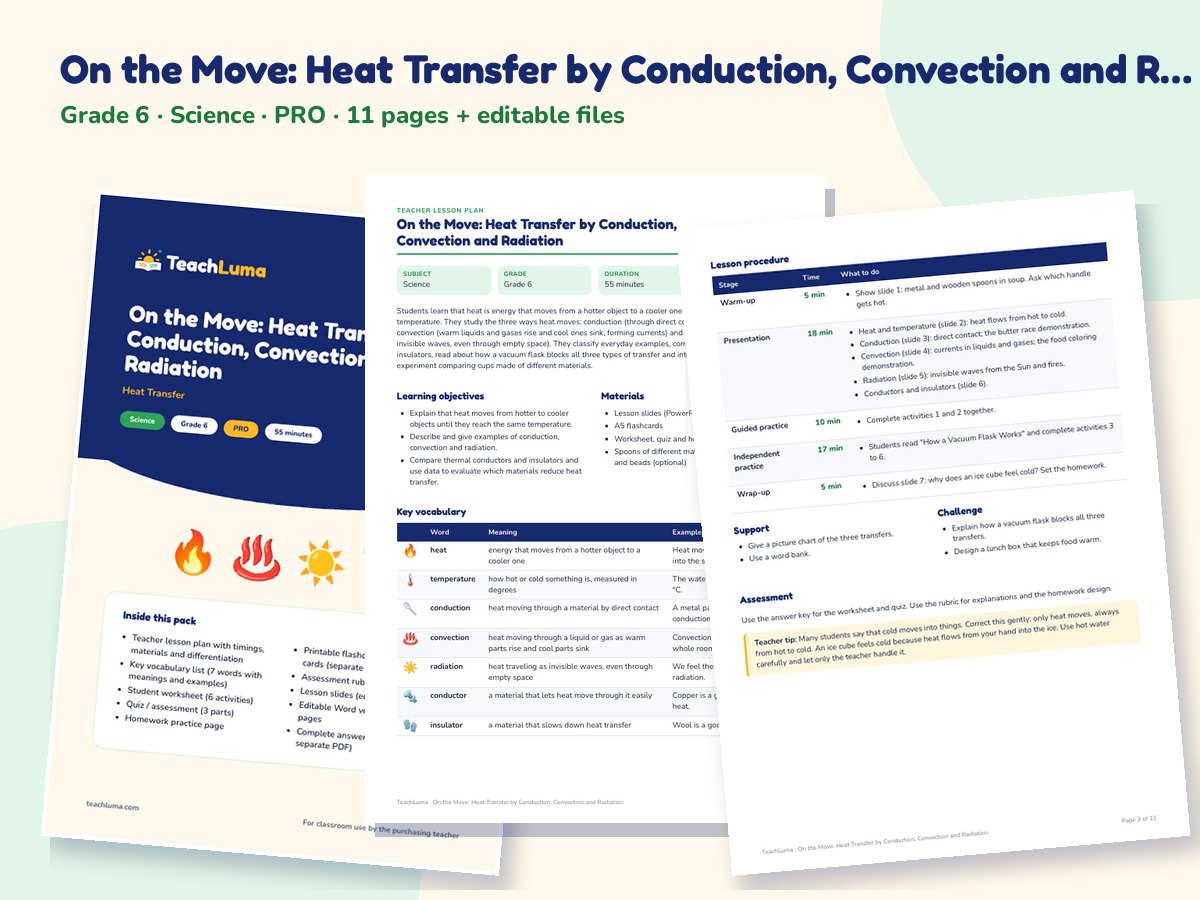
  • 11-page printable PDF lesson pack: teacher lesson plan with timings, materials and differentiation
  • Key vocabulary list (7 words with meanings and examples)
  • Student worksheet (6 activities)
  • Quiz / assessment (3 parts)
  • Homework practice page
  • Printable flashcards: 7 A5 picture cards (separate PDF)
  • Assessment rubric (4 levels)
  • Lesson slides (editable PowerPoint)
  • Editable Word version of all student pages
  • Complete answer key (also as a separate PDF)

Additional Files

  • Lesson Slides (PPTX)
  • Editable Student Pages and Lesson Plan (DOCX)
  • A5 Flashcards (PDF)
  • Answer Key (PDF)

Teacher Reviews

No ratings yet

Be the first teacher to review this resource.

Sign in to review this resource.

Related Resources

Advertisement