Grade 5 Ecosystems and Habitats Grading Rubric
About This Resource
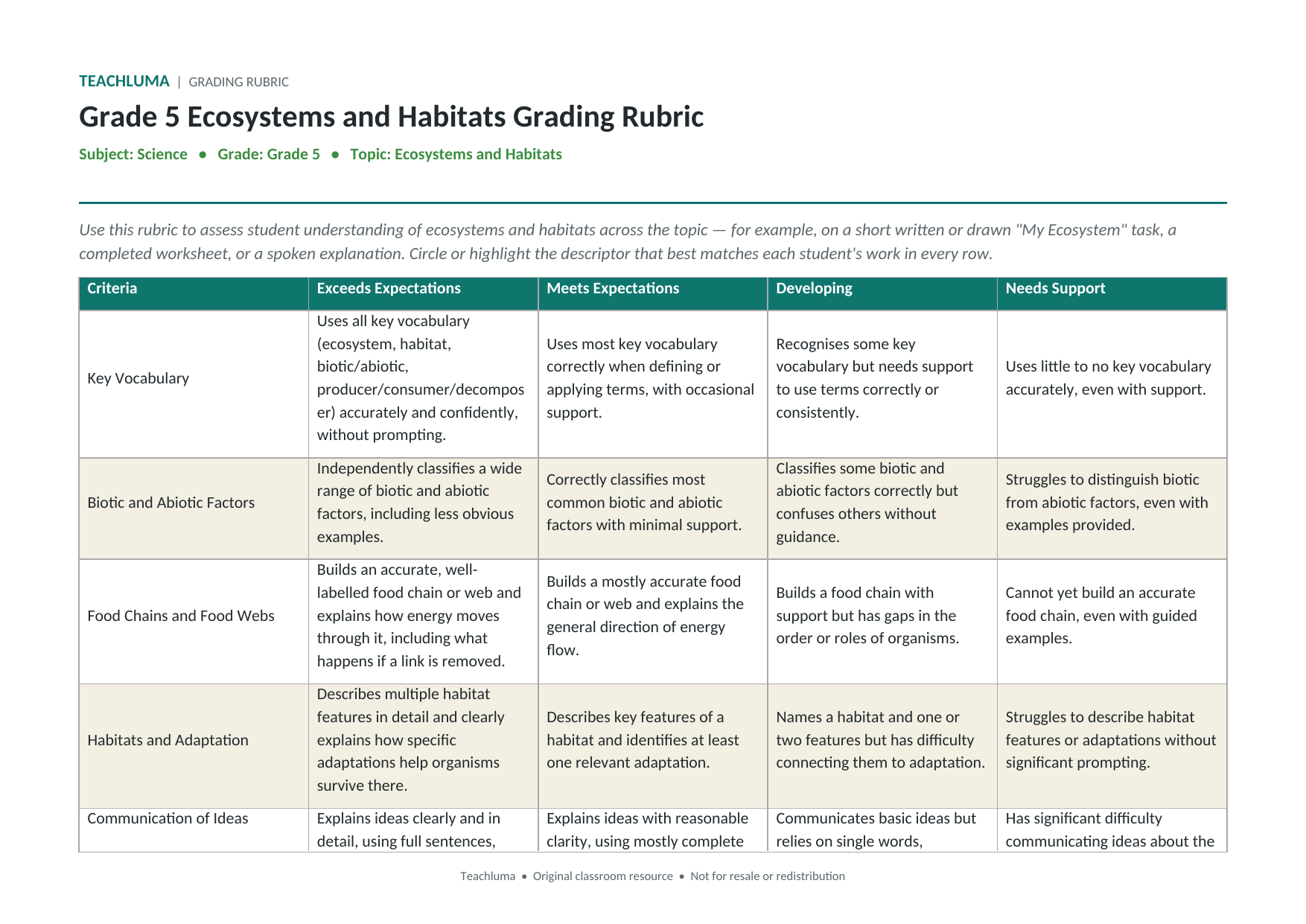
A one-page teacher rubric for assessing Grade 5 student understanding of ecosystems and habitats, covering key vocabulary, biotic and abiotic factors, food chains and food webs, habitats and adaptation, and communication of ideas. It's for Science teachers who want a consistent, ready-made way to grade a task, project, or written response tied to this topic, across four clear performance levels.
Overview
The rubric sets out five criteria that match the topic's core learning goals, each described across four performance levels: Exceeds Expectations, Meets Expectations, Developing, and Needs Support. It is designed to be used with any assessable task from this collection — a written response, a labelled diagram, a completed worksheet, or a short spoken explanation — rather than tied to one specific resource, so it stays useful across the whole topic.
Resource Details
- Subject
- Science
- Topic
- Ecosystems and Habitats
- Category
- Life Science
- File Type
- File Size
- 45.1 KB
- Published
- 07 Sep 2026
- Downloads
- 0
Free download — no account required.
Teaching this in class? Try our free Random Name Picker & Timer.
Learning Objectives
- This rubric assesses the objectives taught across the topic: defining ecosystem, habitat, biotic, and abiotic factors; classifying living and non-living things; explaining the roles of producers, consumers, and decomposers; constructing and explaining a food chain; and describing habitat features and adaptations.
How to Use This Resource
- Choose or design a task that lets students show what they know about ecosystems and habitats — this could be the "My Ecosystem" task suggested in the Lesson Plan, a completed worksheet from this collection, or a short oral explanation. Read or observe the student's work against each row of the rubric and mark the column that best matches their performance for that criterion; a student can land in different columns for different rows. Share the rubric with students beforehand if you want them to understand what a strong response looks like.
Classroom Activity Ideas
- After returning graded rubrics, ask students to choose one row where they were "Developing" and write or say one thing they will do to move toward "Meets Expectations." This keeps the rubric feeding back into learning rather than being only a final grade.
Differentiation
SUPPORT: Read each row aloud with the student and allow drawn, spoken, or first-language responses to count as evidence of understanding where appropriate.
ON-LEVEL: Students are assessed using the rubric as written.
CHALLENGE: Ask students who consistently reach "Exceeds Expectations" to explain their reasoning to a peer who is working toward "Meets Expectations," which reinforces their own understanding while supporting a classmate.
What's Included
- 1-page grading rubric
- Editable DOCX version
- Print-ready PDF version
Additional Files
Teacher Reviews
No ratings yet
Be the first teacher to review this resource.
Related Resources
Grade 5 Living Things and Their Habitats Sorting Activity
Classroom Activity · Living Things and Their Habitats
A three-part classroom activity that has Grade 5 students sort living and non-living thing...
View ResourceGrade 5 Habitats of Southeast Asia Reading Comprehension Worksheet
Reading Activity · Habitats
A three-page reading comprehension worksheet built around an original passage, "Life in th...
View ResourceGrade 5 Food Chains and Food Webs Worksheet
Worksheet · Food Chains and Food Webs
A three-part worksheet that gives Grade 5 students hands-on practice with food chains and ...
View ResourceGrade 5 Ecosystems and Habitats Vocabulary and Concepts PowerPoint
PowerPoint · Ecosystems and Habitats
A 17-slide PowerPoint that introduces Grade 5 students to ecosystems and habitats: key voc...
View ResourceGrade 5 Ecosystems and Habitats Lesson Plan
Lesson Plan · Ecosystems and Habitats
A complete three-lesson plan that introduces Grade 5 students to ecosystems and habitats, ...
View ResourceGrade 4 The Water Cycle Lesson Plan
Lesson Plan · The Water Cycle
A complete 50–60 minute lesson plan introducing the four stages of the water cycle — evapo...
View ResourceAdvertisement