Skip to content
Preview
Members Only Science Classroom Activity Grade 5
No ratings yet

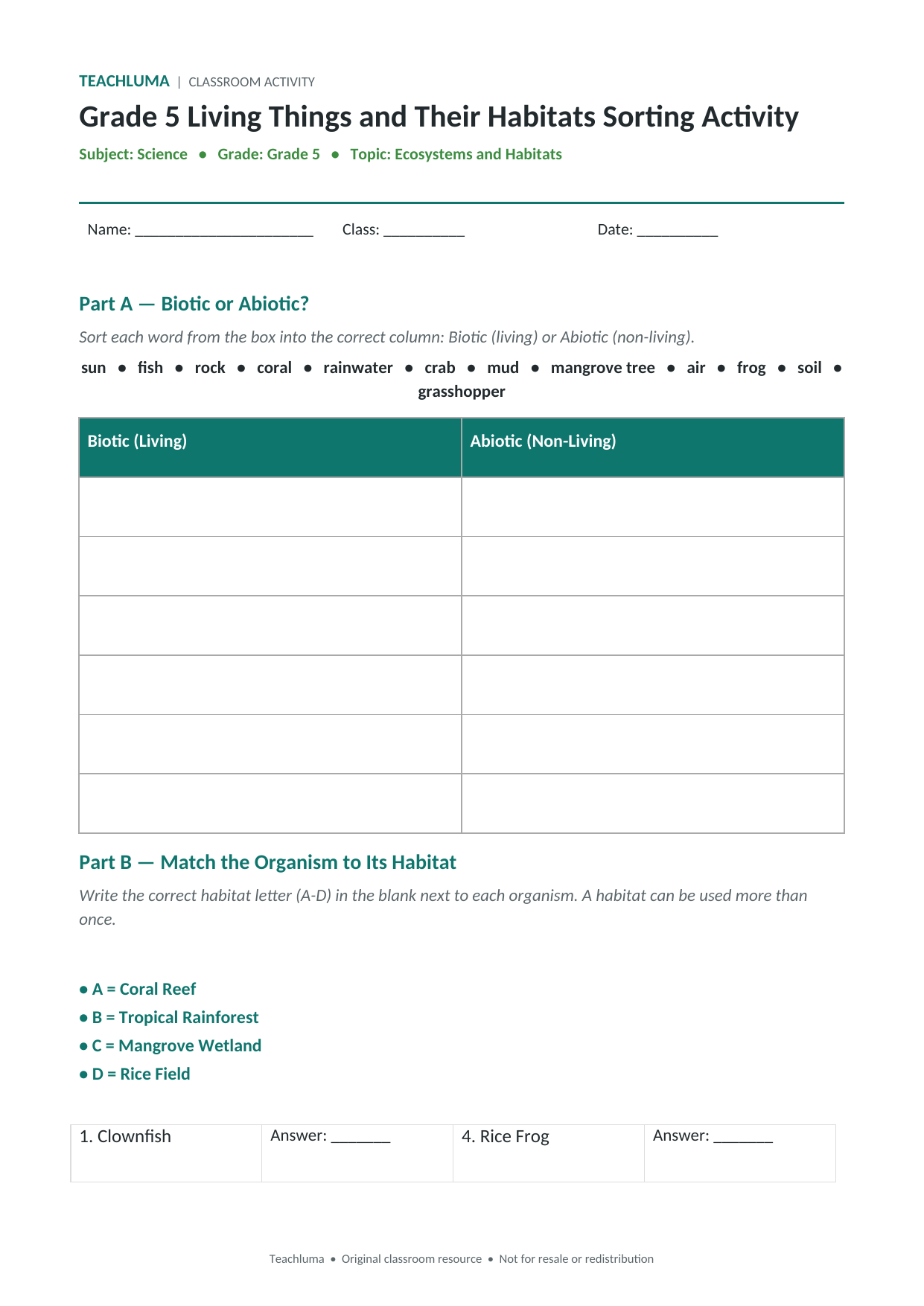
Grade 5 Living Things and Their Habitats Sorting Activity

About This Resource

A three-part classroom activity that has Grade 5 students sort living and non-living things, match organisms to their Southeast Asian habitats, and reason about how specific adaptations help organisms survive. It's for Science teachers who want a hands-on, varied activity to reinforce biotic/abiotic classification and habitat knowledge without another straight worksheet.

Overview

Part A asks students to sort twelve words into biotic and abiotic columns. Part B is a matching activity connecting six organisms — including a clownfish, an orangutan, and a mudskipper — to one of four Southeast Asian habitats, with habitats reused since more than one organism can share a home. Part C, "Adaptation Detective," gives students a first-person clue about an adaptation and asks them to identify the habitat and explain why the adaptation helps, which pushes past simple recall into reasoning.

Resource Details

Subject
Science
Topic
Living Things and Their Habitats
Category
Life Science
File Type
PDF
File Size
47.6 KB
Published
07 Sep 2026
Downloads
0

Members Only

Upgrade to Teacher Pro (from ฿199/month) to download this resource.

Share:

Looking for something different? Request a Resource.


Grade 5 50-60 Minutes Sorting Activity Living Things and Their Habitats

How to Play

  • This activity fits well as independent practice right after Lesson 1 of the Lesson Plan (Part A specifically) and can be picked up again later in the topic for Parts B and C once habitats and adaptation have been introduced. It can be completed individually, in pairs, or as a table-group activity where students discuss each sort before writing an answer.

Variations

  • Turn Part B into a physical sorting game: label four corners of the room with the four habitat names and call out each organism for students to run to the matching corner, before they complete the written version on paper.

Teacher Tips

For Part C, read the first clue aloud in character (as if the organism were speaking) before students see the page — it makes the "detective" framing land and signals that they are meant to reason from a description, not just recall a fact.

Learning Objectives

  • Students will be able to classify living and non-living things as biotic or abiotic.
  • Students will be able to match organisms to the Southeast Asian habitat they are most likely to live in.
  • Students will be able to explain how a specific adaptation helps an organism survive in its habitat.

Differentiation

SUPPORT: Provide a small picture next to each organism name in Part B. For Part C, offer the habitat word bank (Coral Reef, Tropical Rainforest, Mangrove Wetland, Rice Field) visibly at the top of the page, and accept a phrase rather than a full sentence for the explanation.
ON-LEVEL: Students complete all three parts independently, writing full-sentence explanations for Part C.
CHALLENGE: Ask students to write their own "Adaptation Detective" clue for a fifth organism and challenge a partner to guess the habitat.

Assessment

Mark Parts A and B for a quick right/wrong check. Read student explanations in Part C for evidence that they understand why the adaptation helps, not just that they matched the correct habitat.

What's Included

  • 3-page classroom activity
  • Editable DOCX version
  • Print-ready PDF version
  • Answer key with sample explanations for Part C

Additional Files

  • Grade 5 Living Things and Their Habitats Sorting Activity.docx (DOCX)
  • Answer Key.pdf (PDF)

Teacher Reviews

No ratings yet

Be the first teacher to review this resource.

Sign in to review this resource.

Related Resources

Advertisement