Skip to content
Preview
Free Science Reading Activity Grade 5
No ratings yet

Grade 5 Habitats of Southeast Asia Reading Comprehension Worksheet

About This Resource

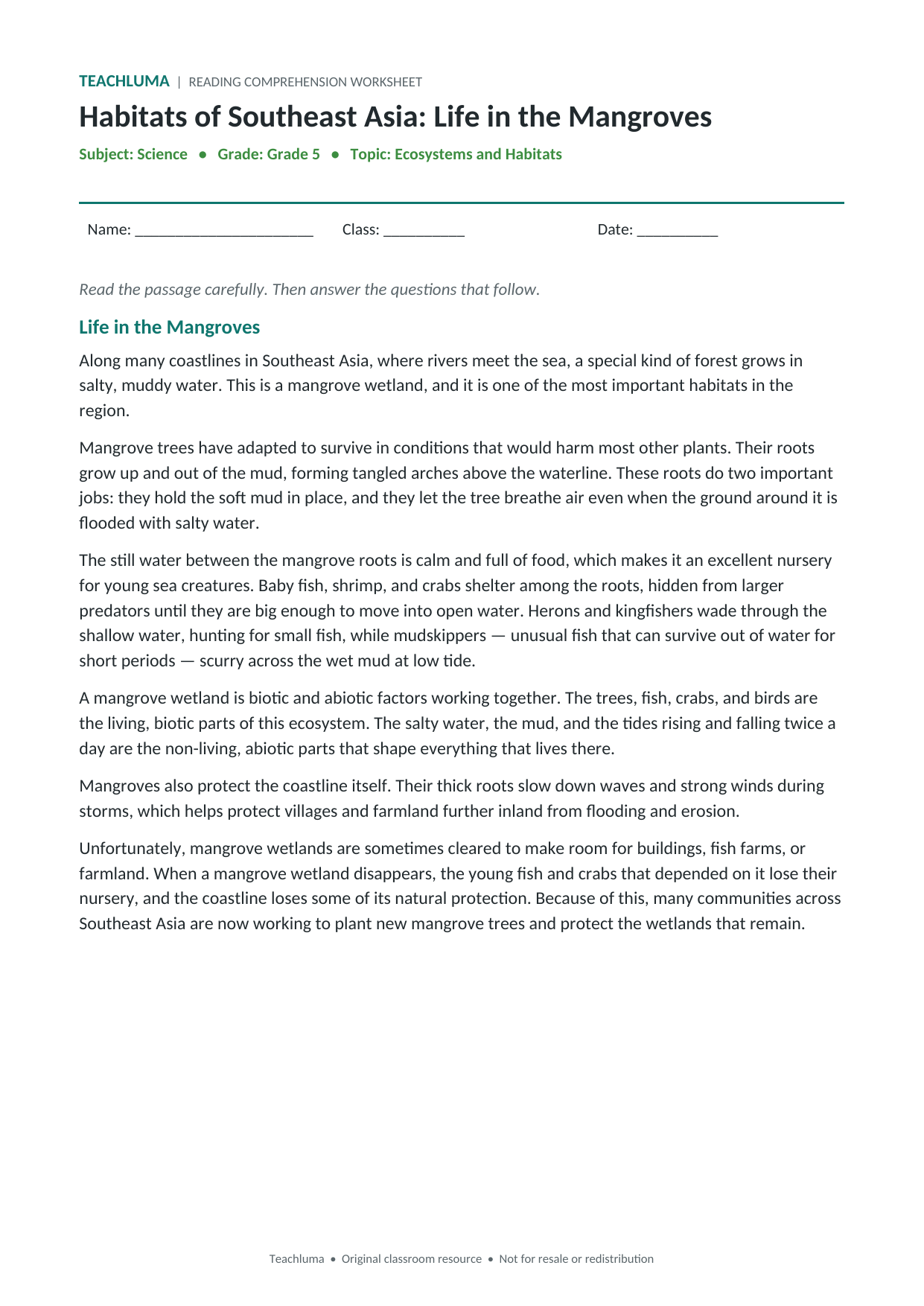
A three-page reading comprehension worksheet built around an original passage, "Life in the Mangroves," about a mangrove wetland habitat found along many Southeast Asian coastlines. It's for Grade 5 Science (or combined Science/ESL reading) teachers who want a content-rich passage that reinforces ecosystem vocabulary — biotic, abiotic, adaptation, predator — while giving students genuine reading comprehension practice.

Overview

Students read a 370-word original passage describing how mangrove trees adapt to salty, muddy conditions, why the still water among their roots makes an ideal nursery for young sea creatures, and how the wetland protects the coastline and is sometimes threatened by clearing. Four question types follow: multiple choice, true/false, short-answer, and vocabulary-in-context, giving 15 questions in total that check both literal comprehension and the ability to reason about new vocabulary from its use in a sentence.

Resource Details

Subject
Science
Topic
Habitats
Category
Life Science
File Type
PDF
File Size
47.2 KB
Published
07 Sep 2026
Downloads
9
Download

Free download — no account required.

Teaching this in class? Try our free Random Name Picker & Timer.

Share:

Looking for something different? Request a Resource.

Learning Objectives

  • Students will be able to identify key details from an informational text about a habitat.
  • Students will be able to classify biotic and abiotic factors described in a passage.
  • Students will be able to use context clues to work out the meaning of unfamiliar vocabulary.
  • Students will be able to explain, in their own words, why a habitat matters to the organisms that live there.

How to Use This Resource

  • Read the passage aloud as a class first, or have students read it independently or in pairs, depending on reading level. Pause after each paragraph to check understanding of new vocabulary before moving to the questions. Students can complete Parts A and B independently, but Parts C and D (short answer and vocabulary in context) often benefit from a brief class discussion of what a strong answer looks like before students write their own.

Classroom Activity Ideas

  • In pairs, have students act out being a "young fish" hiding among the mangrove roots while a partner plays a wading heron looking for food — a short, physical way to reinforce why the calm water among the roots works as a nursery, before moving into the vocabulary questions.

Differentiation

SUPPORT: Read the passage aloud paragraph by paragraph, pausing to explain new vocabulary with a simple picture or gesture. Allow single-word or partial-sentence answers for Part C, and let students underline the sentence containing each vocabulary word in Part D before they answer.
ON-LEVEL: Students complete all four parts independently, writing full sentences for Parts C and D.
CHALLENGE: Ask students to write one additional true/false question of their own about the passage and swap with a partner to answer.

Assessment

Use the completed worksheet as a formal check for understanding, or mark only Parts A and B for a quick check and use Parts C and D as a discussion-based formative check instead.

Teacher Tips

Before handing out the worksheet, ask students to predict what kind of tree could survive in salty, muddy water. It builds curiosity and gives them a reason to read closely for the answer, rather than skimming past the explanation of mangrove roots.

What's Included

  • 3-page student worksheet (passage + questions)
  • Editable DOCX version
  • Print-ready PDF version
  • Answer key with sample answers for short-answer and vocabulary questions

Additional Files


Teacher Reviews

No ratings yet

Be the first teacher to review this resource.

Sign in to review this resource.

Related Resources

Advertisement