Skip to content
Preview
Free Science Worksheet Grade 6 (Year 7)
No ratings yet

Hair-Raising Science: Static Electricity

About This Resource

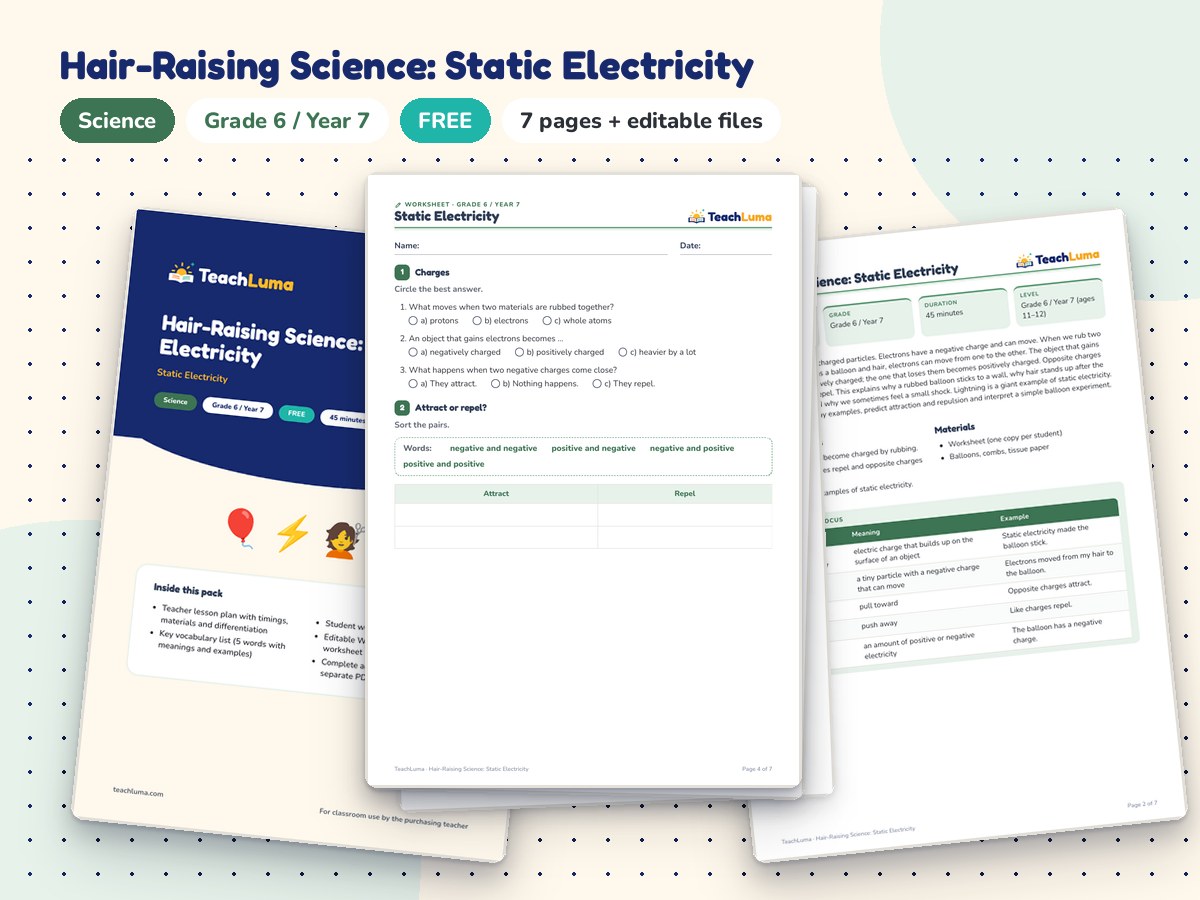
A free Grade 6 science worksheet on static electricity. Students learn that rubbing two materials can move negative charges (electrons) from one to the other, that like charges repel and opposite charges attract, and explain everyday examples such as a balloon sticking to a wall, clothes clinging after drying and small shocks from a door handle. Includes a timed lesson plan, an editable Word version and an answer key.

Overview

All materials contain tiny charged particles. Electrons have a negative charge and can move. When we rub two materials together, such as a balloon and hair, electrons can move from one to the other. The object that gains electrons becomes negatively charged; the one that loses them becomes positively charged. Opposite charges attract and like charges repel. This explains why a rubbed balloon sticks to a wall, why hair stands up after the balloon is lifted away and why we sometimes feel a small shock. Lightning is a giant example of static electricity. Students explain everyday examples, predict attraction and repulsion and interpret a simple balloon experiment.

Resource Details

Subject
Science
Topic
Static Electricity
Category
Forces & Energy
File Type
PDF
File Size
215.9 KB
Published
20 Nov 2026
Downloads
0
Download Free

Free with a TeachLuma account — it takes a minute.

Share:

Looking for something different? Request a Resource.


Grade 6 (ages 11–12) 45 minutes Explaining predicting interpreting results

Student Task

  • Rub a balloon on your hair and hold it near a student's hair. Ask: "What is happening?"
  • Teach charges and the attract/repel rule, then do activities 1 and 2 together.
  • Students complete activities 3 to 5. Answers are in the answer key.

Classroom Use

  • Balloon wall: rub balloons and see how long they stick to the wall.
  • Bending water: hold a charged comb near a thin stream of tap water.
  • Paper dance: a charged ruler picks up small bits of tissue paper.

Differentiation

Support: give a charge diagram with plus and minus signs to label. Challenge: students explain why a charged balloon can attract a neutral wall.

Answer Key & Assessment

Activities 1 to 4 check understanding (answer key included). Activity 5 shows whether students can explain a real example.

Learning Objectives

  • Explain how objects become charged by rubbing.
  • State that like charges repel and opposite charges attract.
  • Explain everyday examples of static electricity.

Teacher Tips

Static experiments work best on dry days. Keep explanations simple: electrons move; protons stay in place. Remind students that static shocks from everyday objects are small, but lightning is very dangerous.

What's Included

  • 7-page printable PDF lesson pack: teacher lesson plan with timings, materials and differentiation
  • Key vocabulary list (5 words with meanings and examples)
  • Student worksheet (5 activities)
  • Editable Word version of the worksheet
  • Complete answer key (also as a separate PDF)

Additional Files


Teacher Reviews

No ratings yet

Be the first teacher to review this resource.

Sign in to review this resource.

Related Resources

Advertisement