Grade 6 Six Simple Machines Classification Worksheet
About This Resource
A two-page worksheet where Grade 6 students match definitions to the six simple machines, classify real-life examples, explain their thinking in short answers, label a lever diagram, and try a bonus challenge on compound machines. Written in simple, clear English for classrooms where many students are still building their English.
Overview
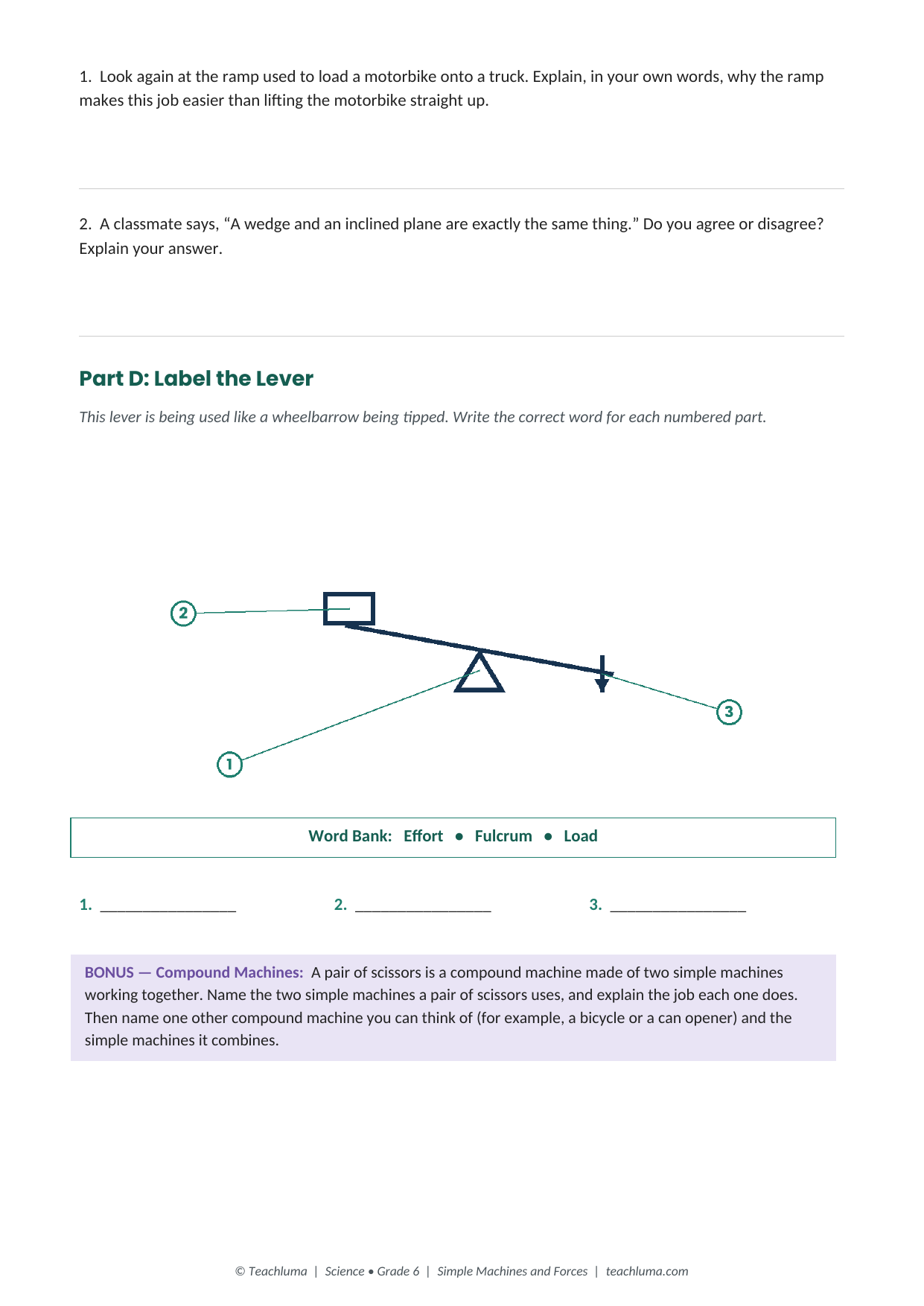
This worksheet gives students four ways to practise the same core content, so it works as a genuine assessment of understanding rather than a single repeated activity type. Part A asks students to match a plain-language definition to the correct simple machine. Part B presents eight real-life examples set in familiar Southeast Asian contexts — a motorbike ramp, a village well, a construction site — and asks students to classify which simple machine each one uses. Part C asks two short-answer questions that push students to explain their reasoning rather than just recall a term. Part D is a labelling diagram of a lever, and a bonus section asks students to think about scissors as a compound machine built from two simple machines.
Resource Details
- Subject
- Science
- Topic
- Simple Machines Classification
- Category
- Forces & Energy
- File Type
- File Size
- 62.3 KB
- Published
- 07 Sep 2026
- Downloads
- 0
Members Only
Upgrade to Teacher Pro (from ฿199/month) to download this resource.
Only need a few resources, not a full subscription? This one's also included in:
Simple Machines and Forces — Complete Topic Bundle — ฿99 one-timeStudent Task
- Use this worksheet after teaching the Vocabulary and Concepts PowerPoint, either as independent practice in the same lesson or as a follow-up task. Students can work alone or in pairs. Part A and B can be checked quickly as a class using the answer key; Part C is best reviewed individually, since answers will vary in wording. The bonus section works well as an extension for students who finish early, or as a short whole-class discussion to close the lesson.
Classroom Use
- Real Object Swap: after finishing the worksheet, have students bring (or draw) one object from home that uses a simple machine, then walk around in pairs comparing objects and identifying each other's machine before checking with the word bank.
Differentiation
SUPPORT: Read each Part B example aloud before students write an answer, allow students to point to the word bank instead of writing the full word, pair students with a partner who can help translate a difficult example, and skip the bonus section if time or confidence is limited.
ON-LEVEL: Complete Parts A to D independently, writing full answers for Part C in complete sentences.
CHALLENGE: Complete the bonus section, and add a labelled sketch of one additional compound machine not already mentioned in class.
Answer Key & Assessment
Completed worksheet, teacher observation during pair or independent work, and class discussion of the bonus compound machines question.
Learning Objectives
- Students will be able to match each of the six simple machines to its correct definition.
- Students will be able to classify real-life examples by the simple machine they use.
- Students will be able to explain, in their own words, why a simple machine makes a task easier.
- Students will be able to label the fulcrum, load, and effort on a diagram of a lever.
- Students will be able to describe how a compound machine combines more than one simple machine.
Teacher Tips
For Part C question 2, some students will confidently say a wedge and an inclined plane are the same because both use a slanted surface — this is a useful moment to bring the class back to the diagrams from the PowerPoint and ask what actually moves in each case (the object, or the machine itself).
What's Included
- 2-page student worksheet with an original labelled diagram
- Editable DOCX version
- Print-ready PDF version
- Answer key, including sample answers for the short-response questions
Additional Files
- Grade 6 Six Simple Machines Classification Worksheet.docx
- Answer Key.pdf
Teacher Reviews
No ratings yet
Be the first teacher to review this resource.
Related Resources
Grade 6 Simple Machines and Forces Grading Rubric
Grading Rubric · Simple Machines and Forces
A four-level grading rubric for assessing Grade 6 student understanding of forces and simp...
View ResourceGrade 6 Simple Machines and Forces Teacher's Guide
Teacher Resource · Simple Machines and Forces
A background reading guide for teachers delivering this topic, covering the science behind...
View ResourceGrade 6 Simple Machines and Forces Quiz
Quiz · Simple Machines and Forces
A 24-point summative quiz covering force, friction, gravity, and the six simple machines, ...
View ResourceGrade 6 Spot the Simple Machine Review Activity
Game · Simple Machine Review
A whole-class bingo review game where Grade 6 students build their own unique bingo card b...
View ResourceGrade 6 Force and Friction Investigation Activity
Classroom Activity · Force and Friction
A hands-on, low-resource group investigation where Grade 6 students use a block, string, a...
View ResourceGrade 6 Simple Machines Reading Comprehension Activity
Reading Activity · Simple Machines and Forces
A two-page reading passage about a family's busy market day, where Grade 6 students meet a...
View ResourceAdvertisement