Skip to content
Preview
Free Science Worksheet Grade 6 (Year 7)
No ratings yet

Same Mass, Different Weight: Mass and Weight

About This Resource

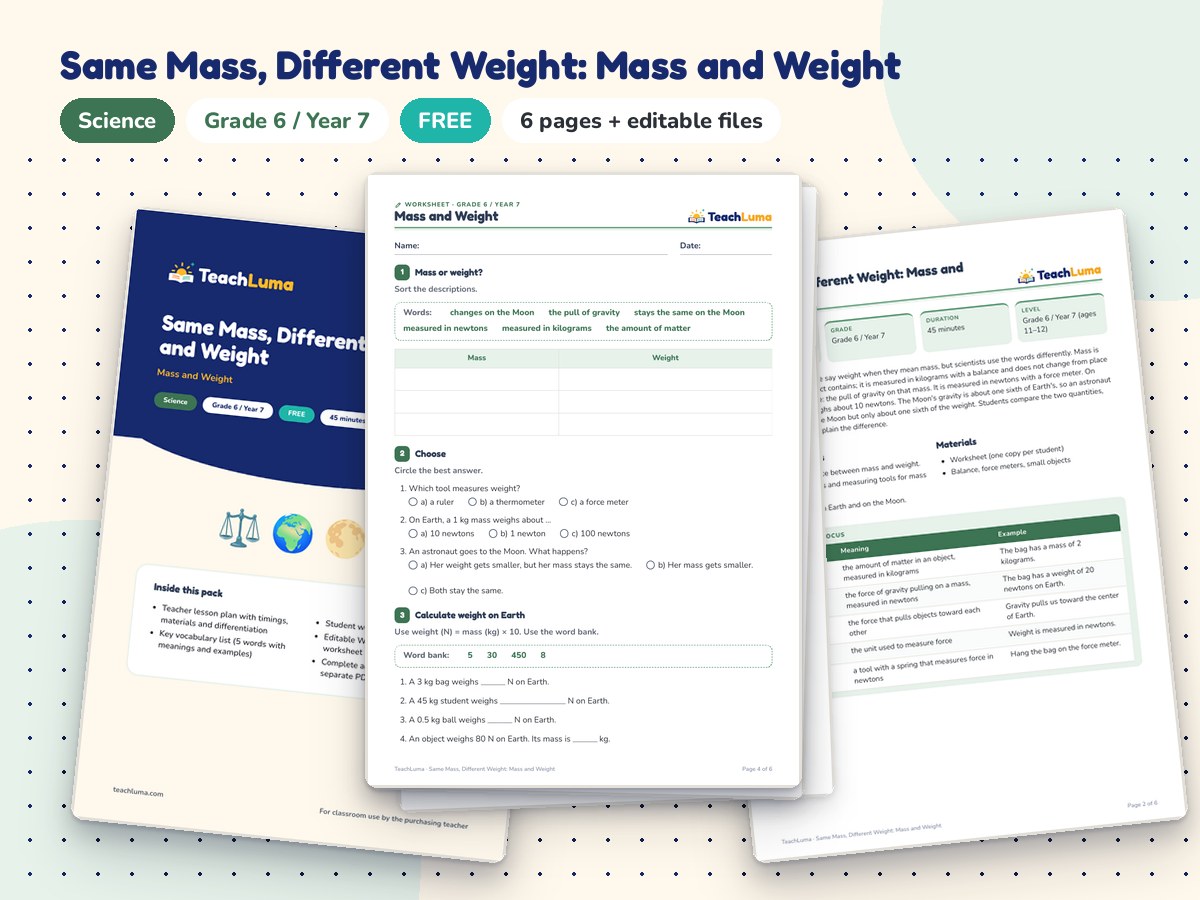
A free Grade 6 science worksheet on the difference between mass and weight. Students learn that mass is the amount of matter in an object, measured in kilograms, while weight is the pull of gravity on that mass, measured in newtons. They calculate weights on Earth and the Moon and correct everyday misconceptions. Includes a timed lesson plan, an editable Word version and an answer key.

Overview

In everyday speech people say weight when they mean mass, but scientists use the words differently. Mass is how much matter an object contains; it is measured in kilograms with a balance and does not change from place to place. Weight is a force: the pull of gravity on that mass. It is measured in newtons with a force meter. On Earth, each kilogram weighs about 10 newtons. The Moon's gravity is about one sixth of Earth's, so an astronaut has the same mass on the Moon but only about one sixth of the weight. Students compare the two quantities, calculate weights and explain the difference.

Resource Details

Subject
Science
Topic
Mass and Weight
Category
Forces & Energy
File Type
PDF
File Size
274.3 KB
Published
14 Nov 2026
Downloads
0
Download Free

Free with a TeachLuma account — it takes a minute.

Share:

Looking for something different? Request a Resource.


Grade 6 (ages 11–12) 45 minutes Scientific vocabulary calculation measuring reasoning

Student Task

  • Ask: "If you went to the Moon, would you be lighter? Would there be less of you?"
  • Teach mass and weight with examples, then do activities 1 and 2 together.
  • Students complete activities 3 to 5. Answers are in the answer key.

Classroom Use

  • Measure both: students find the mass of objects with a balance and their weight with a force meter.
  • Planet weights: students calculate the weight of a 50 kg astronaut on different planets.
  • Misconception hunt: students find everyday sentences that mix up mass and weight.

Differentiation

Support: give a two-column chart comparing mass and weight. Challenge: students calculate weights on Mars (about 4 N per kg) and Jupiter (about 25 N per kg).

Answer Key & Assessment

Activities 1 to 4 check understanding and calculations (answer key included). Activity 5 shows whether students can explain the difference in their own words.

Learning Objectives

  • Explain the difference between mass and weight.
  • Use the correct units and measuring tools for mass and weight.
  • Calculate weight on Earth and on the Moon.

Teacher Tips

Use 10 newtons per kilogram for easy calculations, and mention that the more exact value is about 9.8. Stress that a bathroom scale really measures force but shows the result in kilograms for convenience.

What's Included

  • 6-page printable PDF lesson pack: teacher lesson plan with timings, materials and differentiation
  • Key vocabulary list (5 words with meanings and examples)
  • Student worksheet (5 activities)
  • Editable Word version of the worksheet
  • Complete answer key (also as a separate PDF)

Additional Files


Teacher Reviews

No ratings yet

Be the first teacher to review this resource.

Sign in to review this resource.

Related Resources

Advertisement