Skip to content
Preview
Members Only Science Complete Lesson Pack Grade 5 (Year 6)
No ratings yet

Into the Unknown: How We Explore Space

About This Resource

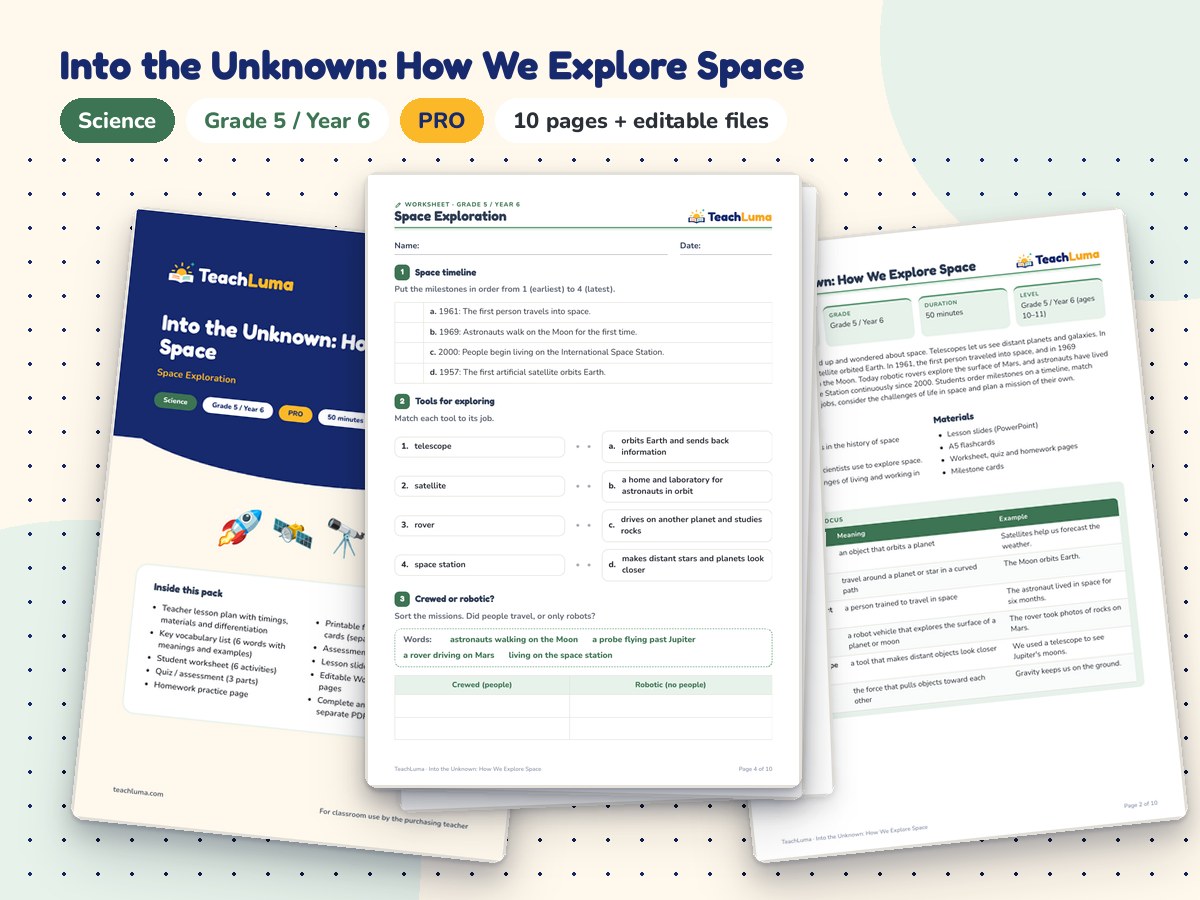
A complete Grade 5 science pack on space exploration. Students follow key milestones from the first satellite in 1957 to people living on a space station, compare tools such as telescopes, satellites, rovers and crewed spacecraft, and explore the challenges of living in space. Includes slides, a lesson plan, worksheet, quiz, homework, A5 flashcards, a rubric, Word files and answer keys.

Overview

People have always looked up and wondered about space. Telescopes let us see distant planets and galaxies. In 1957, the first artificial satellite orbited Earth. In 1961, the first person traveled into space, and in 1969 astronauts first walked on the Moon. Today robotic rovers explore the surface of Mars, and astronauts have lived on the International Space Station continuously since 2000. Students order milestones on a timeline, match exploration tools to their jobs, consider the challenges of life in space and plan a mission of their own.

Resource Details

Subject
Science
Topic
Space Exploration
Category
Earth & Space
File Type
PDF
File Size
326.2 KB
Published
14 Nov 2026
Downloads
0

Members Only

Create a free account to download this resource with one of your 3 Free Pro Previews, or upgrade to Teacher Pro (from ฿199/month) for the whole library.

Share:

Looking for something different? Request a Resource.

Grade 5 (ages 10–11) 50 minutes Reading for information sequencing comparing reasoning

Learning Objectives

  • Order key milestones in the history of space exploration.
  • Compare the tools scientists use to explore space.
  • Explain some challenges of living and working in space.

How to Use This Resource

  • Show a photo of Earth from space. Ask: "How do we know what space is like?"
  • Teach the timeline and tools with the slides, then do activities 1 and 2 together.
  • Students complete activities 3 to 6. Use the quiz and send the homework page home.

Classroom Activity Ideas

  • Human timeline: students hold milestone cards and stand in date order.
  • Rover challenge: one student guides a blindfolded partner across the room with short commands, like controlling a rover from far away.
  • Pack for space: groups choose ten items for a six-month stay and justify each choice.

Differentiation

Support: give the timeline with dates and students add the events. Challenge: students compare the costs and benefits of robotic and crewed missions in a short paragraph.

Assessment

Use the worksheet and quiz to check knowledge of milestones and tools. Use the rubric for the mission plan in the homework.

Teacher Tips

Help students understand the difference between crewed missions (with people) and robotic missions (no people). Robots can travel further and for longer because they do not need air, food or a return trip.

What's Included

  • 10-page printable PDF lesson pack: teacher lesson plan with timings, materials and differentiation
  • Key vocabulary list (6 words with meanings and examples)
  • Student worksheet (6 activities)
  • Quiz / assessment (3 parts)
  • Homework practice page
  • Printable flashcards: 6 A5 picture cards (separate PDF)
  • Assessment rubric (4 levels)
  • Lesson slides (editable PowerPoint)
  • Editable Word version of all student pages
  • Complete answer key (also as a separate PDF)

Additional Files

  • Lesson Slides (PPTX)
  • Editable Student Pages and Lesson Plan (DOCX)
  • A5 Flashcards (PDF)
  • Answer Key (PDF)

Teacher Reviews

No ratings yet

Be the first teacher to review this resource.

Sign in to review this resource.

Related Resources

Advertisement