Skip to content
Preview
Members Only Science Complete Lesson Pack Grade 6 (Year 7)
No ratings yet

Living Light: Bioluminescence

About This Resource

A complete Grade 6 science pack on bioluminescence. Students learn that some living things make their own light through a chemical reaction, explore examples such as fireflies, anglerfish and glowing fungi, compare bioluminescence with reflection and fluorescence, and explain four ways glowing helps organisms survive: finding mates, attracting prey, escaping predators and camouflage. Includes slides, a lesson plan, worksheet, quiz, homework, A5 flashcards, a rubric, Word files and answer keys.

Overview

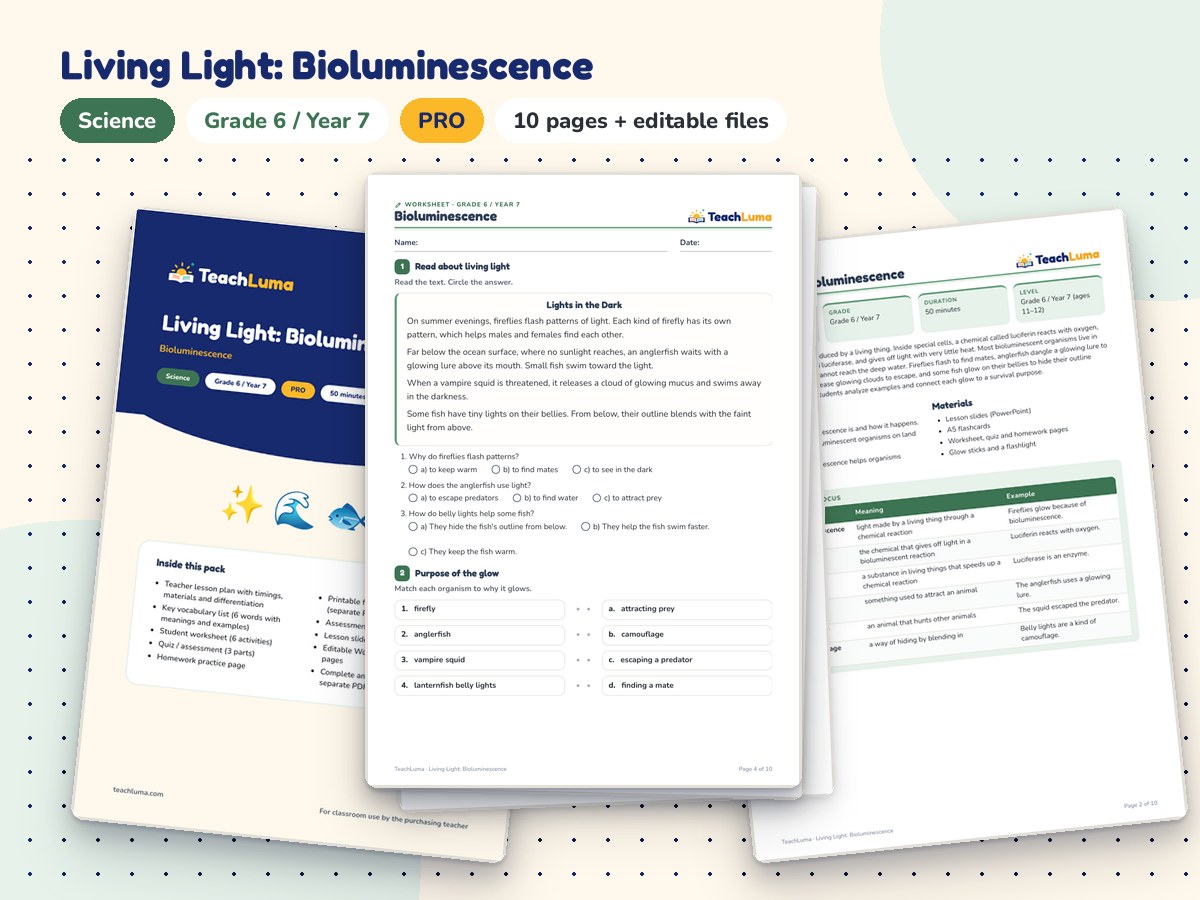
Bioluminescence is light produced by a living thing. Inside special cells, a chemical called luciferin reacts with oxygen, helped by an enzyme called luciferase, and gives off light with very little heat. Most bioluminescent organisms live in the ocean, where sunlight cannot reach the deep water. Fireflies flash to find mates, anglerfish dangle a glowing lure to attract prey, some squid release glowing clouds to escape, and some fish glow on their bellies to hide their outline against faint light above. Students analyze examples and connect each glow to a survival purpose.

Resource Details

Subject
Science
Topic
Bioluminescence
Category
Living Things
File Type
PDF
File Size
337.9 KB
Published
26 Nov 2026
Downloads
0

Members Only

Create a free account to download this resource with one of your 3 Free Pro Previews, or upgrade to Teacher Pro (from ฿199/month) for the whole library.

Share:

Looking for something different? Request a Resource.

Grade 6 (ages 11–12) 50 minutes Life science adaptations classifying explaining

Learning Objectives

  • Explain what bioluminescence is and how it happens.
  • Give examples of bioluminescent organisms on land and in the sea.
  • Explain how bioluminescence helps organisms survive.

How to Use This Resource

  • Show a photo of glowing waves at night. Ask: "What could be making this light?"
  • Teach bioluminescence with the slides, then do activities 1 and 2 together.
  • Students complete activities 3 to 6. Use the quiz and send the homework page home.

Classroom Activity Ideas

  • Glow stick model: compare a glow stick's chemical light with a flashlight.
  • Purpose sort: match organisms to the reason they glow.
  • Deep sea design: invent a creature that uses light to survive.

Differentiation

Support: give a four-purpose chart with pictures. Challenge: research why most bioluminescent light in the sea is blue or green.

Assessment

Use the worksheet and quiz to check understanding. Use the rubric for the homework design.

Teacher Tips

Glow sticks are a safe way to show chemical light that needs no electricity. Point out that they warm up very little, like real bioluminescence.

What's Included

  • 10-page printable PDF lesson pack: teacher lesson plan with timings, materials and differentiation
  • Key vocabulary list (6 words with meanings and examples)
  • Student worksheet (6 activities)
  • Quiz / assessment (3 parts)
  • Homework practice page
  • Printable flashcards: 6 A5 picture cards (separate PDF)
  • Assessment rubric (4 levels)
  • Lesson slides (editable PowerPoint)
  • Editable Word version of all student pages
  • Complete answer key (also as a separate PDF)

Additional Files

  • Lesson Slides (PPTX)
  • Editable Student Pages and Lesson Plan (DOCX)
  • A5 Flashcards (PDF)
  • Answer Key (PDF)

Teacher Reviews

No ratings yet

Be the first teacher to review this resource.

Sign in to review this resource.

Related Resources

Advertisement