Skip to content
Preview
Members Only Science Complete Lesson Pack Grade 6 (Year 7)
No ratings yet

Living Together: Symbiosis in Ecosystems

About This Resource

A complete Grade 6 science lesson pack on symbiosis: the close relationships between different species, mutualism where both partners benefit, commensalism where one benefits and the other is unaffected, parasitism where one benefits and the host is harmed, how these relationships differ from predation and competition, and why they matter for healthy ecosystems. Includes slides, a timed lesson plan, flashcards, worksheet, quiz, homework, rubric and answer key.

Overview

Students explore how living things depend on one another. They learn that symbiosis is a close, long-term relationship between two different species and study its three types using plus, zero and minus signs: mutualism (+ +), commensalism (+ 0) and parasitism (+ −). Through examples such as bees and flowers, clownfish and sea anemones, barnacles on whales and ticks on dogs, they classify relationships, read about the cleaner wrasse, compare symbiosis with predation and competition, and explain how removing one partner can affect a whole ecosystem.

Resource Details

Subject
Science
Topic
Symbiosis: Relationships in Ecosystems
Category
Living Things
File Type
PDF
File Size
370.7 KB
Published
04 Nov 2026
Downloads
0

Members Only

Upgrade to Teacher Pro (from ฿199/month) to download this resource.

Share:

Looking for something different? Request a Resource.

Grade 6 (ages 11–12) 55 minutes Life science classifying using evidence comparing explaining

Learning Objectives

  • Define symbiosis and describe mutualism, commensalism and parasitism.
  • Classify relationships between organisms using evidence of benefit or harm.
  • Explain how symbiotic relationships affect the survival of species and the balance of an ecosystem.

How to Use This Resource

  • Start with slide 1: a photo-style prompt of a clownfish in a sea anemone. Ask, "Why doesn't the anemone sting the clownfish?"
  • Teach the three types of symbiosis with the slides and the plus-zero-minus code, then do activities 1 and 2 together.
  • Students complete activities 3 to 6, then use the quiz to check and the homework partner cards. Answers are in the answer key.

Classroom Activity Ideas

  • Partner hunt: give each student a card with one organism. Students find their symbiotic partner and decide together which type of relationship they have.
  • Plus, zero, minus: hold up a relationship and students show + +, + 0 or + − with hand signals.
  • Schoolyard survey: look for lichen on walls or trees, insects visiting flowers or galls on leaves, and record the relationships found.

Differentiation

Support: give a plus-zero-minus chart with picture examples and a word bank. Challenge: research lichen (a partnership between a fungus and an alga) and explain why scientists call it mutualism.

Assessment

Worksheet activities 1 to 5 and the quiz check the three types, classification and comparison with other relationships (answer key included). Activity 6 and the homework are assessed with the rubric.

Teacher Tips

Students often confuse parasitism with predation. Point out that a parasite usually lives on or in its host for a long time and needs the host to stay alive, while a predator eats its prey quickly.

What's Included

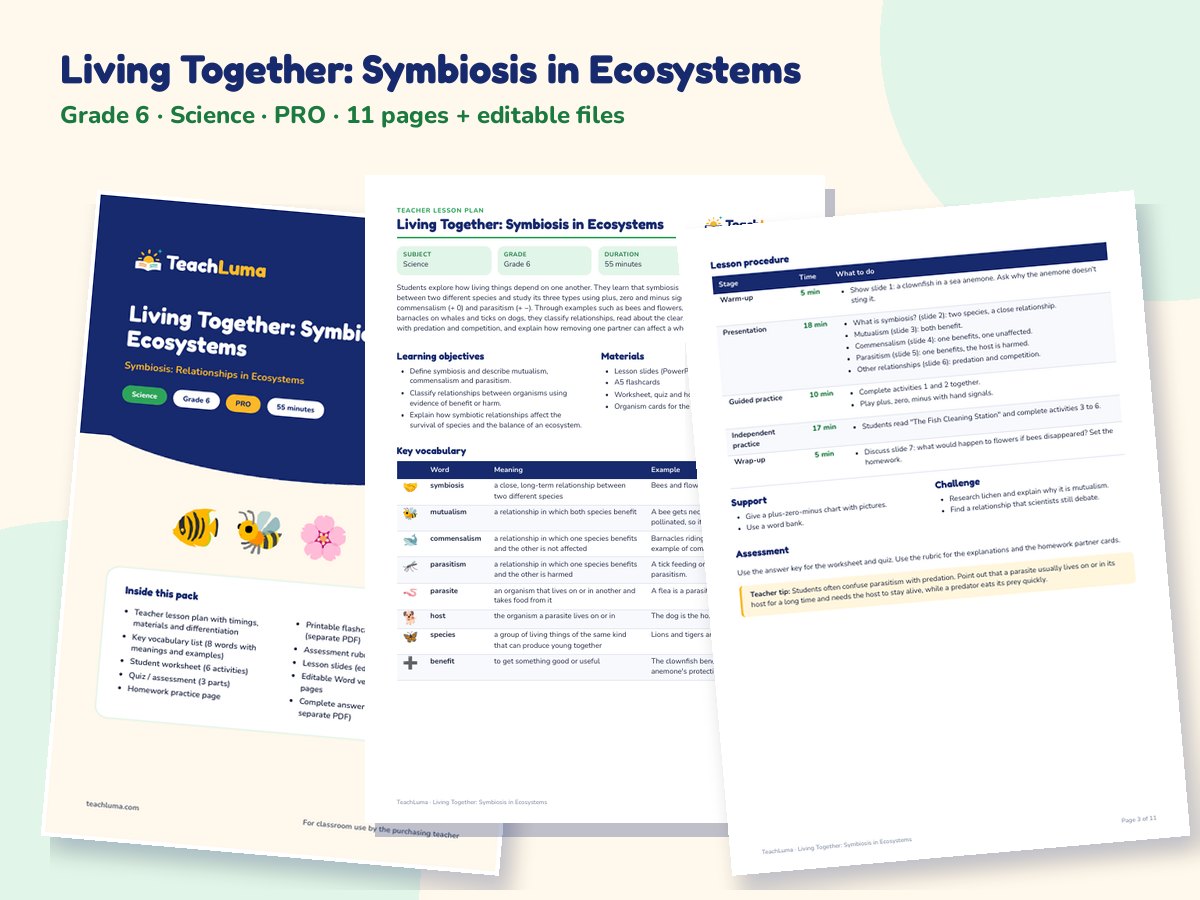
  • 11-page printable PDF lesson pack: teacher lesson plan with timings, materials and differentiation
  • Key vocabulary list (8 words with meanings and examples)
  • Student worksheet (6 activities)
  • Quiz / assessment (3 parts)
  • Homework practice page
  • Printable flashcards: 8 A5 picture cards (separate PDF)
  • Assessment rubric (4 levels)
  • Lesson slides (editable PowerPoint)
  • Editable Word version of all student pages
  • Complete answer key (also as a separate PDF)

Additional Files

  • Lesson Slides (PPTX)
  • Editable Student Pages and Lesson Plan (DOCX)
  • A5 Flashcards (PDF)
  • Answer Key (PDF)

Teacher Reviews

No ratings yet

Be the first teacher to review this resource.

Sign in to review this resource.

Related Resources

Advertisement