Skip to content
Preview
Members Only Science Complete Lesson Pack Grade 6 (Year 7)
No ratings yet

The Variety of Life: Biodiversity

About This Resource

A complete Grade 6 science pack on biodiversity: what it means, why places such as rainforests and coral reefs have so many species, why variety makes ecosystems stronger, the main threats (habitat loss, pollution, invasive species, overfishing and climate change) and how people protect wildlife. Students carry out and analyze a quadrat survey. Includes slides with notes, a lesson plan, worksheet, quiz, homework, flashcards, a rubric and answer keys.

Overview

Students learn that biodiversity is the variety of living things in a place, from tiny insects and fungi to large trees and mammals. They compare habitats with high and low biodiversity, find out why rainforests and coral reefs are so rich in life, and see how a varied ecosystem is better at coping with change. They investigate the main threats to biodiversity and the ways people protect it, such as nature reserves, seed banks and cleaner rivers. In a quadrat survey, students count the different species in a small square of ground and compare two areas of the school grounds.

Resource Details

Subject
Science
Topic
Biodiversity
Category
Animals
File Type
PDF
File Size
378.1 KB
Published
09 Nov 2026
Downloads
0

Members Only

Upgrade to Teacher Pro (from ฿199/month) to download this resource.

Share:

Looking for something different? Request a Resource.

Grade 6 (ages 11–12) 60 minutes Life science sampling recording and comparing data evaluating explaining

Learning Objectives

  • Explain what biodiversity is and why it matters to ecosystems and people.
  • Describe the main threats to biodiversity and ways to protect it.
  • Use a quadrat survey to compare the biodiversity of two areas.

How to Use This Resource

  • Start with the slides: compare a picture of a coral reef with a picture of a mown sports field and ask which has more kinds of living things.
  • Teach the key ideas with the slides and flashcards, then carry out the quadrat survey and do worksheet activities 1 and 2 together.
  • Students complete activities 3 to 6, then use the quiz and send the homework page home.

Classroom Activity Ideas

  • Quadrat survey: place a 1 m square frame on a lawn and on a wild corner of the school grounds and count the different species in each.
  • Block tower ecosystem: build a tower of wooden blocks labeled with species; remove blocks as threats happen and discuss when the ecosystem becomes unstable.
  • Protect it poster: groups design a poster about one threatened animal in their country and how people can help.

Differentiation

Support: give a picture key of common school-ground plants and minibeasts for the survey. Challenge: students explain why using several quadrats in each area gives more reliable results than using one.

Assessment

Use the worksheet and quiz to check understanding of biodiversity, threats and protection. Use the rubric during the quadrat survey and for the homework action plan.

Teacher Tips

Biodiversity is about the number of different kinds of living things, not the total number of living things. A lawn may have thousands of grass plants but only a few species. Students do not need to name every species in the survey; they can describe them (small round leaf, yellow flower).

What's Included

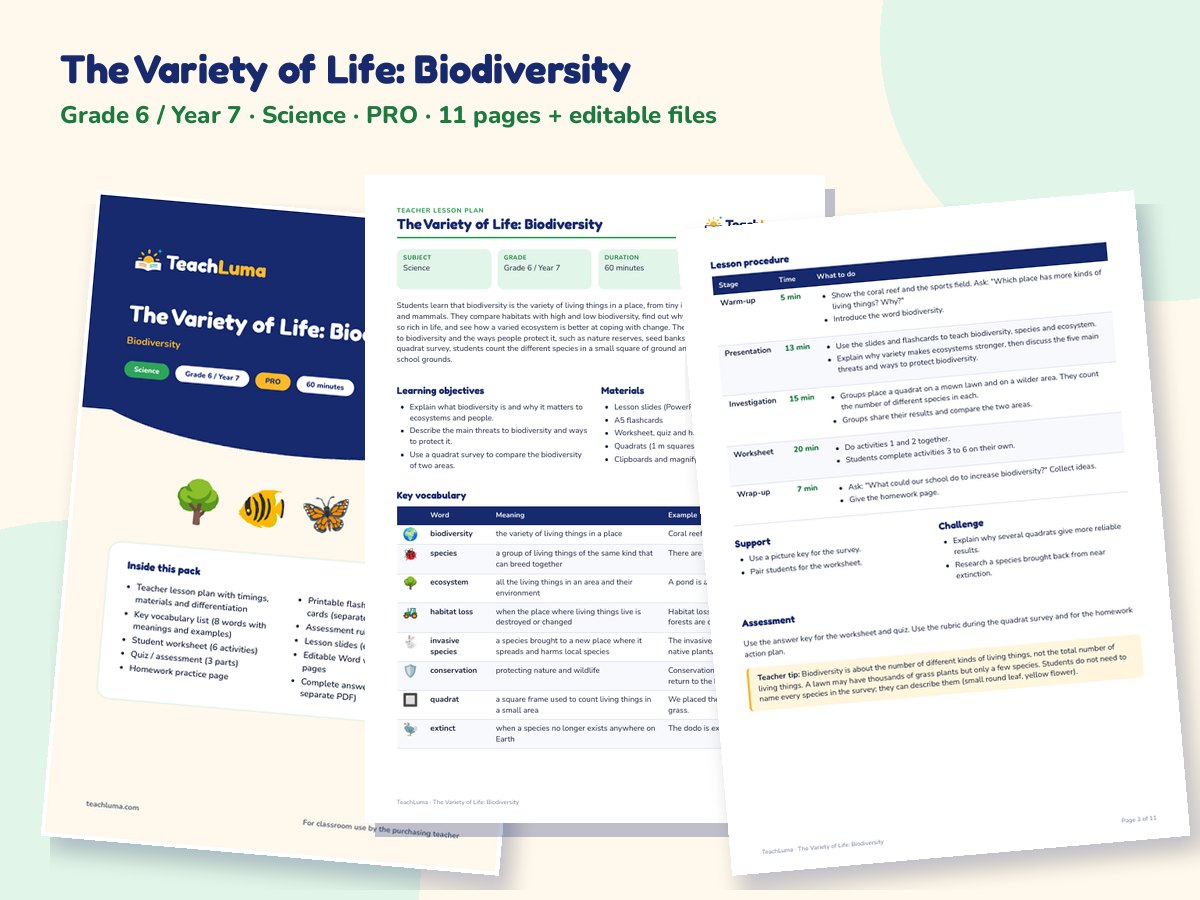
  • 11-page printable PDF lesson pack: teacher lesson plan with timings, materials and differentiation
  • Key vocabulary list (8 words with meanings and examples)
  • Student worksheet (6 activities)
  • Quiz / assessment (3 parts)
  • Homework practice page
  • Printable flashcards: 8 A5 picture cards (separate PDF)
  • Assessment rubric (4 levels)
  • Lesson slides (editable PowerPoint)
  • Editable Word version of all student pages
  • Complete answer key (also as a separate PDF)

Additional Files

  • Lesson Slides (PPTX)
  • Editable Student Pages and Lesson Plan (DOCX)
  • A5 Flashcards (PDF)
  • Answer Key (PDF)

Teacher Reviews

No ratings yet

Be the first teacher to review this resource.

Sign in to review this resource.

Related Resources

Advertisement