Grade 2 Animal Groups Vocabulary Worksheet
About This Resource
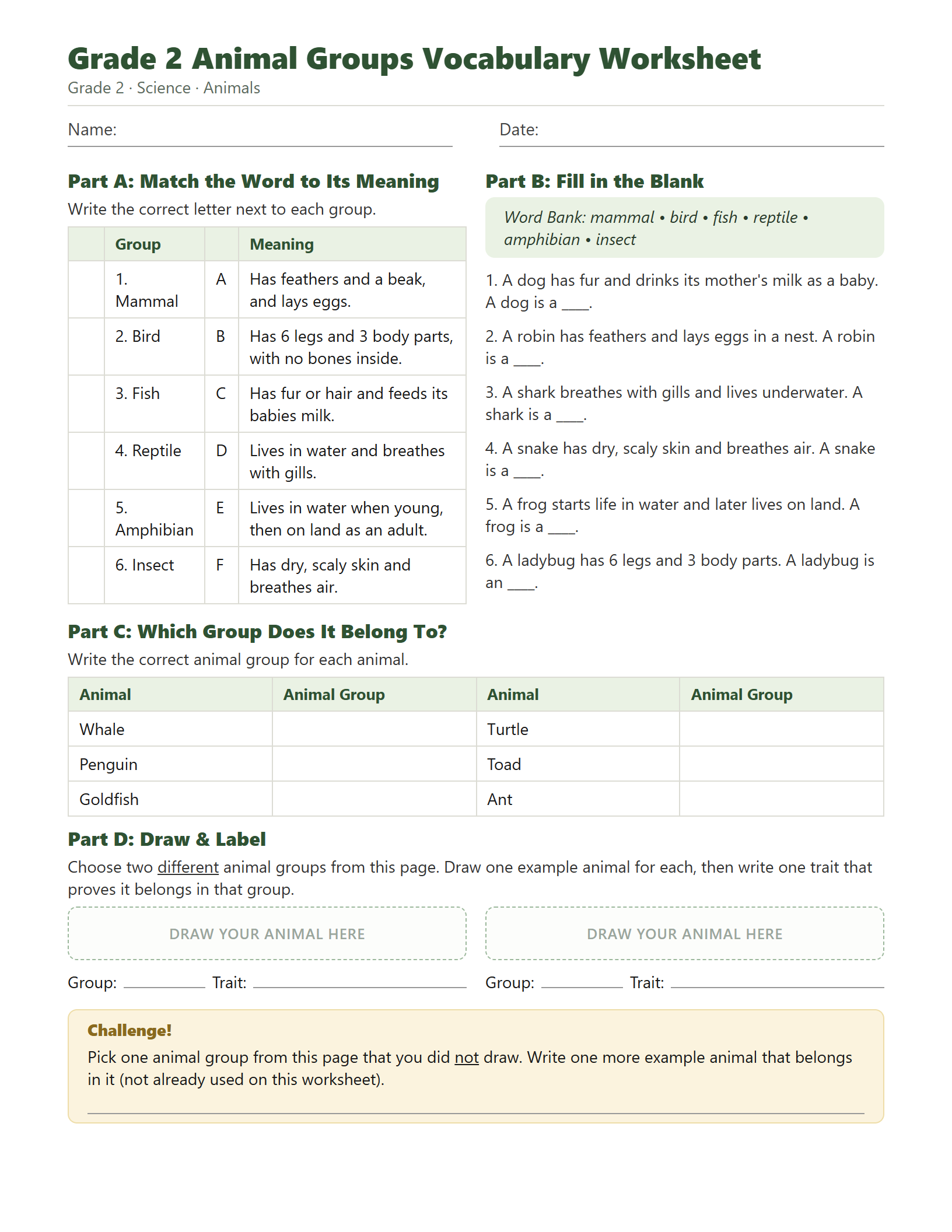
A one-page vocabulary worksheet that checks whether students can define, use, apply, and generate examples for the six animal group terms (mammal, bird, fish, reptile, amphibian, insect) introduced in the Animals Introduction PowerPoint — through matching, fill-in-the-blank, an animal-sorting table, and a draw-and-label section.
Overview
This worksheet moves students from recognizing vocabulary to using it. Part A checks definitions through matching, Part B checks the words can be used correctly in context through fill-in-the-blank sentences, Part C checks transfer by asking students to sort six new animals (including two intentionally tricky ones — a whale and a penguin) into the correct group without any definition text as a crutch, and Part D has students draw and label two animals of their own choosing to demonstrate the vocabulary productively, not just recognize it. A Challenge extension asks students to generate one more example.
Resource Details
- Subject
- Science
- Topic
- Animal Groups Vocabulary
- Category
- Animals
- File Type
- File Size
- 98.5 KB
- Published
- 15 Sep 2026
- Downloads
- 0
Members Only
Upgrade to Teacher Pro (from ฿199/month) to download this resource.
Only need a few resources, not a full subscription? This one's also included in:
Grade 2 Animals — Complete Topic Bundle — ฿99 one-timeStudent Task
- Use this after the Animals Introduction PowerPoint and before the Animal Classification Sorting Worksheet, as a vocabulary check-in. Students can work independently or in pairs. Part C is intentionally the hardest scored section — Whale (a mammal that lives in water) and Penguin (a bird that cannot fly) are included on purpose to check students are sorting by traits, not surface appearance. Part D (Draw & Label) is a lower-stakes creative check — students choose two groups themselves rather than being told which ones, which also reveals which groups a student feels least confident about (the ones they avoid). Use the answer key to review as a class immediately afterward so misconceptions don't carry into the Classification Worksheet.
Classroom Use
- After reviewing the answer key, ask students who got Whale or Penguin right to explain their reasoning out loud to the class — hearing a peer explain "it breathes air and drinks milk, so it's a mammal even though it lives in the ocean" reinforces the trait-based thinking for the rest of the class. For Part D, a quick "gallery walk" where students briefly show a neighbor their two drawings works well as a closer.
Differentiation
SUPPORT: Complete Part A and Part B only; skip Part C or complete it with the vocabulary recap slide/notes visible for reference. For Part D, allow drawing from the two groups they feel most confident about.
ON-LEVEL: Completes Parts A-C independently in the suggested order, then Part D choosing two different groups.
CHALLENGE: Completes the Challenge prompt, then writes one additional fill-in-the-blank sentence of their own for a partner to solve.
Answer Key & Assessment
Score Parts A-C out of 18 (6 matching + 6 fill-in-the-blank + 6 categorizing) — see the answer key's scoring summary table. Part D and the Challenge are open-response; score them with the Grade 2 Animals Unit Grading Rubric (3-point scale) or use them only as an informal check for early finishers.
Learning Objectives
- Students will be able to match each of the six animal group names to its correct definition.
- Students will be able to complete a sentence using the correct animal group vocabulary word.
- Students will be able to sort an unfamiliar animal into its correct group based on its traits, not just its habitat or appearance.
- Students will be able to generate (not just recognize) an example animal for a chosen group and state one accurate trait that justifies it.
Teacher Tips
Watch Part C closely — a student who correctly matches definitions in Part A but still sorts a whale as a "fish" in Part C has memorized the words without applying the underlying trait-based reasoning. That's exactly the gap this worksheet is designed to surface before the topic moves on. In Part D, notice which two groups a student picks — the groups they avoid are worth a quick informal check-in.
What's Included
- 1-page worksheet, laid out to use the page efficiently (matching, fill-in-the-blank, sorting, and a draw-and-label section)
- Editable DOCX version
- Print-ready PDF version
- Separate answer key (DOCX + PDF), including a scoring summary table
- 1 preview image
Additional Files
- Grade 2 Animal Groups Vocabulary Worksheet (DOCX)
- Printable Answer Key (PDF)
Teacher Reviews
No ratings yet
Be the first teacher to review this resource.
Related Resources
Grade 2 Animal Habitats Worksheet
Worksheet · Animal Habitats
A one-page worksheet introducing six major habitats — forest, ocean, desert, polar regions...
View Resource
Grade 2 Animal Classification Sorting Worksheet
Worksheet · Animal Classification
A hands-on sorting worksheet where students sort 18 animals — three per group — into the s...
View Resource
Grade 2 Animal Habitat Diorama Mini-Project
Classroom Activity · Animal Habitat Diorama Mini-Project
A hands-on, 40-50 minute craft project where students build a small diorama of one animal ...
View Resource
Grade 2 Animals Unit Grading Rubric
Grading Rubric · Animals
A 2-page, 4-criteria analytic rubric (Accuracy, Reasoning, Completion, Communication) for ...
View Resource
Grade 2 Animals Unit Lesson Plan
Lesson Plan · Animals
A 2-page teacher lesson plan tying the whole Grade 2 Animals topic together into one 4-5 d...
View Resource
Grade 2 Animal Groups Flashcards
Flashcards · Animal Groups
12 print-and-cut flashcards (2 per animal group) for quick review and games. Each card sho...
View ResourceAdvertisement