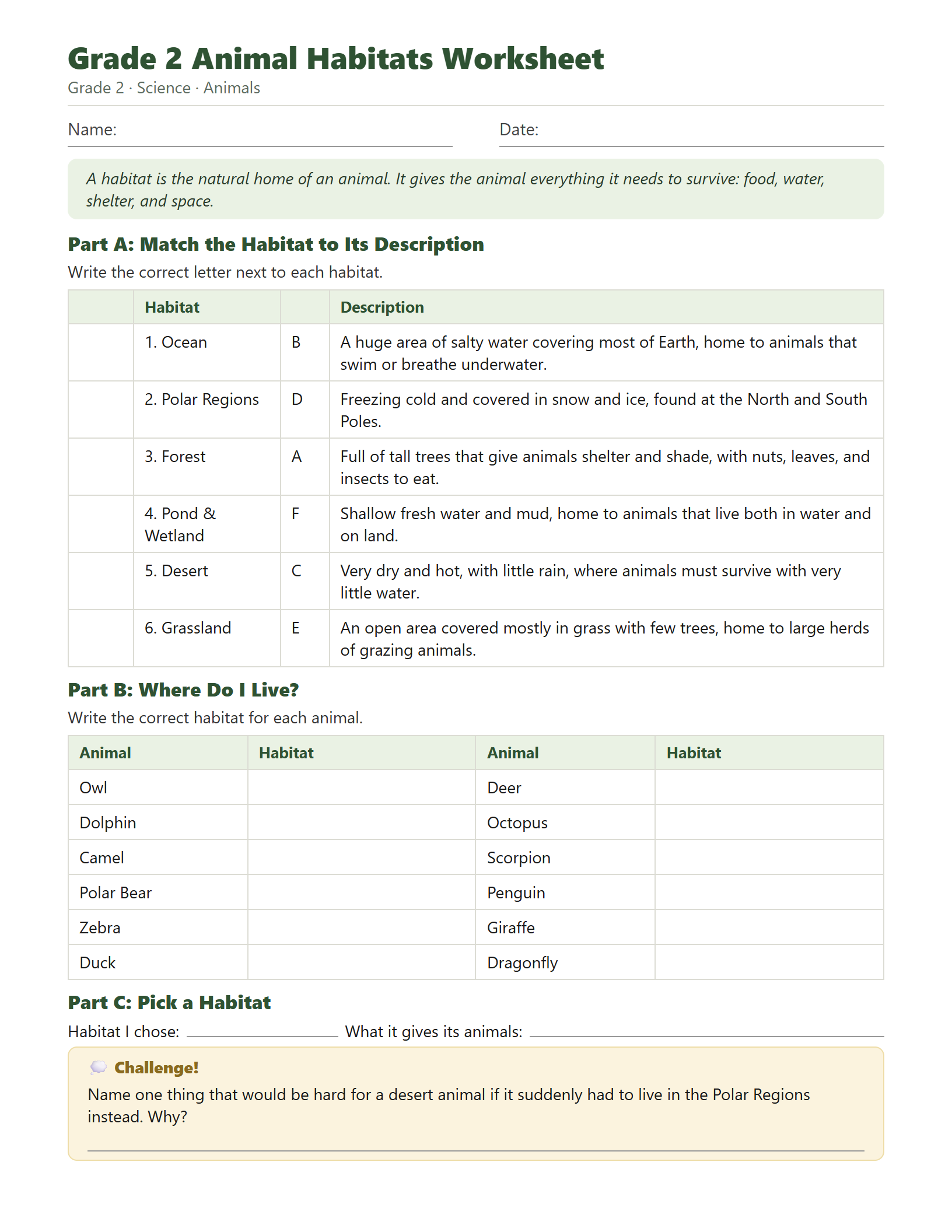
Grade 2 Animal Habitats Worksheet
About This Resource
A one-page worksheet introducing six major habitats — forest, ocean, desert, polar regions, grassland, and pond & wetland — through habitat-description matching and a 12-animal "Where Do I Live?" sorting activity, closing with a short reflection and a critical-thinking challenge about animal adaptation.
Overview
This worksheet fills a genuine gap in the Animals topic: after learning to classify animals by body traits (mammal, bird, fish...), students now learn that animals also depend on a specific habitat suited to their needs. Part A matches each of six habitats to an accurate description. Part B has students place 12 animals (two per habitat) into their correct habitat. Part C asks students to pick one habitat and briefly state what it provides its animals, a quick self-directed check before the Challenge. The Challenge question asks students to reason about why a desert animal couldn't simply live in the Polar Regions, reinforcing that habitats matter because of what an animal actually needs to survive, not just where it happens to be placed.
Resource Details
- Subject
- Science
- Topic
- Animal Habitats
- Category
- Animals
- File Type
- File Size
- 124.3 KB
- Published
- 15 Sep 2026
- Downloads
- 0
Members Only
Upgrade to Teacher Pro (from ฿199/month) to download this resource.
Only need a few resources, not a full subscription? This one's also included in:
Grade 2 Animals — Complete Topic Bundle — ฿99 one-timeStudent Task
- Introduce the term "habitat" using the definition box at the top, then work through Part A together as a class before releasing students to complete Part B, Part C, and the Challenge independently. This worksheet deliberately separates "Polar Regions" as one combined habitat (rather than a single "Arctic") so that both the Polar Bear (true Arctic) and Penguin (true Antarctic) examples are scientifically accurate — point this out explicitly, since many students assume penguins and polar bears live in the same place.
Classroom Use
- Bring in (or project) six large habitat labels around the room. Read each of the 12 animals from Part B aloud one at a time and have students point to or walk toward the correct habitat label, discussing as needed. For Part C, have a few students share their chosen habitat and what it provides before moving to the Challenge, so students hear more than one example of "what a habitat gives its animals" in their own words.
Differentiation
SUPPORT: Complete Part A with the word list visible from the Vocabulary Worksheet's word banks for reference; reduce Part B to 6 animals (one per habitat); complete Part C together as a class example first.
ON-LEVEL: Completes Parts A, B, and C independently, attempts the Challenge with teacher support if needed.
CHALLENGE: Completes the Challenge question fully in writing, then repeats it for a different pair of habitats (e.g., ocean vs. desert) of their own choosing.
Answer Key & Assessment
Score Part A and Part B out of 18 total (6 matches + 12 animal placements) — see the answer key's scoring summary table. Assess Part C and the Challenge response qualitatively for whether the student names a real survival need (temperature, food type, water, or shelter) rather than a superficial difference; use the Grade 2 Animals Unit Grading Rubric for a formal 3-point score if needed.
Learning Objectives
- Students will be able to define a habitat as the place that gives an animal food, water, shelter, and space.
- Students will be able to match each of six habitats to its correct description.
- Students will be able to identify the correct habitat for 12 given animals.
- Students will be able to state, in their own words, one thing a chosen habitat provides its animals.
- Students will be able to explain in simple terms why an animal adapted to one habitat would struggle in a very different one.
Teacher Tips
Use the Polar Bear/Penguin pair as a quick "did you know?" moment — most students assume they live together, and correcting this (Arctic vs. Antarctic) is a memorable, genuinely accurate fact that also reinforces why "habitat" is more specific than just "cold place." The full explanation is in the answer key's teaching note.
What's Included
- 1-page worksheet, using the page efficiently across all three parts plus the Challenge
- Editable DOCX version
- Print-ready PDF version
- Separate answer key (DOCX + PDF), including a Polar Bear/Penguin teaching note and a scoring summary table
- 1 preview image
Additional Files
- Grade 2 Animal Habitats Worksheet (DOCX)
- Printable Answer Key (PDF)
Teacher Reviews
No ratings yet
Be the first teacher to review this resource.
Related Resources
Grade 2 Animal Groups Vocabulary Worksheet
Worksheet · Animal Groups Vocabulary
A one-page vocabulary worksheet that checks whether students can define, use, apply, and g...
View Resource
Grade 2 Animal Classification Sorting Worksheet
Worksheet · Animal Classification
A hands-on sorting worksheet where students sort 18 animals — three per group — into the s...
View Resource
Grade 2 Animal Habitat Diorama Mini-Project
Classroom Activity · Animal Habitat Diorama Mini-Project
A hands-on, 40-50 minute craft project where students build a small diorama of one animal ...
View Resource
Grade 2 Animals Unit Grading Rubric
Grading Rubric · Animals
A 2-page, 4-criteria analytic rubric (Accuracy, Reasoning, Completion, Communication) for ...
View Resource
Grade 2 Animals Unit Lesson Plan
Lesson Plan · Animals
A 2-page teacher lesson plan tying the whole Grade 2 Animals topic together into one 4-5 d...
View Resource
Grade 2 Animal Groups Flashcards
Flashcards · Animal Groups
12 print-and-cut flashcards (2 per animal group) for quick review and games. Each card sho...
View ResourceAdvertisement