Grade 3 Investigating Changes of State: Observation Activity
About This Resource
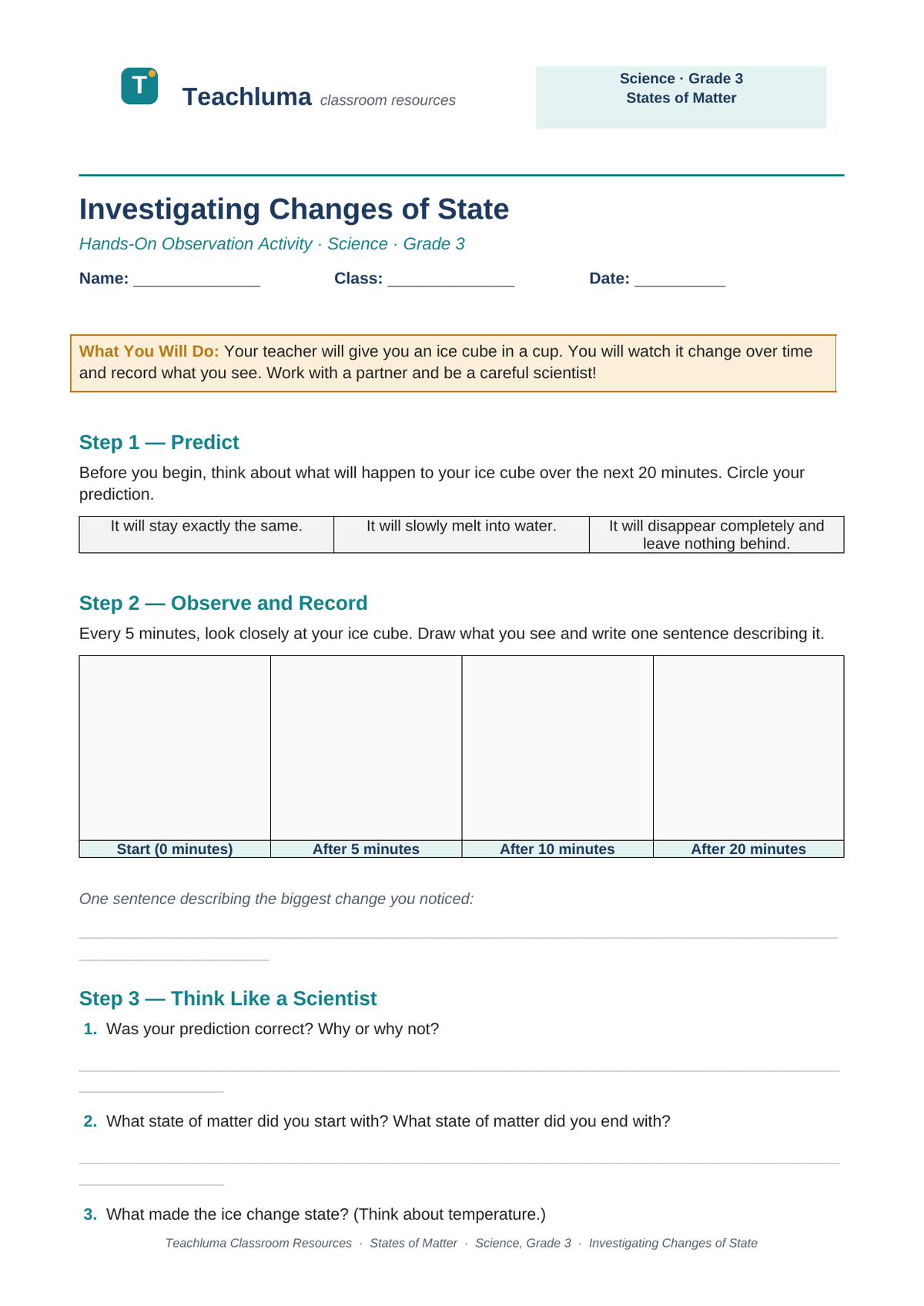
A hands-on activity where students predict, observe, and record what happens as an ice cube melts over 20 minutes, then answer reasoning questions connecting their own results back to the science. A genuine alternative to a standard worksheet, built around real observation rather than matching or fill-in-the-blank.
Overview
Students begin by making a prediction about what will happen to an ice cube over time, then observe and record what they see at four checkpoints (start, 5, 10, and 20 minutes) using a drawing-and-sentence format rather than a fixed-answer table. A short reasoning section afterward asks students to compare their prediction to what actually happened, name the states of matter involved, and think ahead to what would happen if the resulting water were frozen again. A fast-finishers extension pushes students to reason about a second liquid without needing extra teacher preparation, and a teacher note explains how to adapt the activity if fresh ice isn't available in the moment.
Resource Details
- Subject
- Science
- Topic
- State of Matter
- Category
- Materials & Matter
- File Type
- File Size
- 57.8 KB
- Published
- 07 Sep 2026
- Downloads
- 0
Free download — no account required.
Teaching this in class? Try our free Random Name Picker & Timer.
How to Play
- Give each student or pair a small cup with an ice cube (or run this as a station students rotate through during the lesson). Have students complete the prediction step before the ice is distributed, then check back at the 5, 10, and 20 minute marks for them to draw and describe what they observe. Finish with the four reasoning questions, either independently or discussed as a class. If ice isn't practical to bring into the classroom that day, the teacher note explains how to run the same activity using a video or photo sequence instead.
Variations
- Turn this into a simple class investigation by placing identical ice cubes in different locations around the room (in direct sun, in shade, near a fan) and having groups compare which one melts fastest and discuss why.
Teacher Tips
Clear plastic cups make it easiest for students to see the melting process from the side as well as from above — this small change makes a noticeable difference in how much detail students include in their drawings.
Learning Objectives
- Students will be able to make and test a prediction about a change of state.
- Students will be able to record observations of a solid changing to a liquid over time.
- Students will be able to identify the states of matter present at the start and end of an investigation.
- Students will be able to explain what causes a change of state, using the idea of temperature.
Differentiation
Support: Provide sentence starters for the observation boxes (for example, "The ice is now ___") and allow students to describe their observations verbally to a partner who scribes for them.
On-level: Students complete all four observation checkpoints and reasoning questions independently.
Challenge: Students complete the fast-finishers extension comparing a second liquid, and are asked to justify their reasoning using the words particle, temperature, and energy.
Assessment
There is no single fixed answer key for this activity, since predictions and observations will vary by student and by conditions in the room. Use the States of Matter Grading Rubric's "Recording Observations" criterion to assess the quality of each student's predictions, observations, and reasoning.
What's Included
- 2-page observation activity (Word document)
- Print-ready PDF version
Teacher Reviews
No ratings yet
Be the first teacher to review this resource.
Related Resources
Grade 3 States of Matter Quiz
Quiz · States of Matter
A 12-question, 15-point quiz covering solids, liquids, and gases and the four changes of s...
View ResourceGrade 3 States of Matter Reading Comprehension: Mai and the Morning Market
Reading Activity · States of Matter
A short story about a girl helping her grandmother at a market, used to teach states of ma...
View ResourceGrade 3 States of Matter Sorting and Properties Worksheet
Worksheet · State of Matter
A four-part worksheet where students sort ten everyday items into solids, liquids, and gas...
View ResourceGrade 3 States of Matter Vocabulary and Concepts PowerPoint
PowerPoint · State of Matter
A 13-slide teaching presentation that introduces solids, liquids, and gases, walks through...
View ResourceGrade 3 States of Matter Lesson Plan: Solids, Liquids, and Gases
Lesson Plan · State of Matter
A complete, ready-to-teach lesson plan introducing Grade 3 students to the three states of...
View ResourceGrade 2 Plants and How They Grow Review Quiz
Quiz · Plants and How They Grow
An 8-question review quiz covering the whole Plants and How They Grow topic, mixing multip...
View ResourceAdvertisement