Grade 3 States of Matter Grading Rubric
Free Science Grading Rubric Grade 3
No ratings yet

Grade 3 States of Matter Grading Rubric

About This Resource

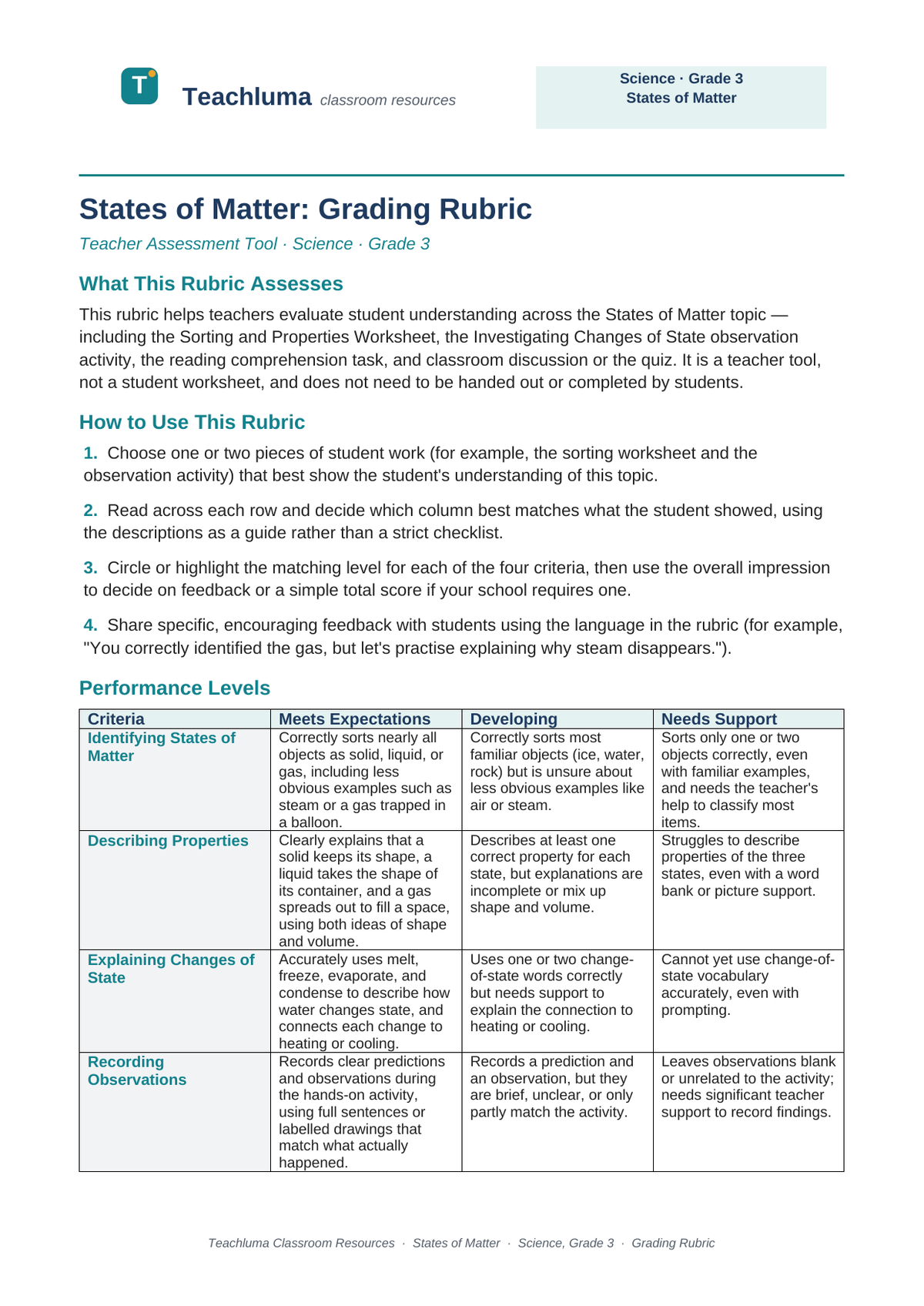
A teacher assessment tool for the States of Matter topic, covering four criteria — identifying states, describing properties, explaining changes of state, and recording observations — across three performance levels. Built to be used alongside the worksheet, reading activity, and hands-on observation task in this collection, with a built-in class tracking grid so a teacher can assess a whole class without extra paperwork.

Overview

This rubric gives teachers a consistent, practical way to judge student understanding across the States of Matter topic, whether that's from the Sorting and Properties Worksheet, the Investigating Changes of State observation activity, the reading task, or classroom discussion. Each of the four criteria is described at three levels — Meets Expectations, Developing, and Needs Support — in plain, specific language rather than vague labels. A second page explains how to interpret each level, offers an optional simple point-scoring approach for schools that require a number, and includes a ready-to-use class tracking grid for recording every student's levels at a glance.

Resource Details

Subject
Science
Topic
States of Matter
Category
Materials & Matter
File Type
PDF
File Size
75.1 KB
Published
07 Sep 2026
Downloads
0
Download

Free download — no account required.

Teaching this in class? Try our free Random Name Picker & Timer.

Share:

Grade 3 Grading Rubric States of Matter

Learning Objectives

  • Students will be able to identify solids, liquids, and gases from everyday examples.
  • Students will be able to describe the properties (shape and volume) of each state of matter.
  • Students will be able to explain changes of state using vocabulary such as melt, freeze, evaporate, and condense.
  • Students will be able to record predictions and observations clearly during a simple investigation.

How to Use This Resource

  • Pick one or two pieces of student work — for example the sorting worksheet plus the observation activity — that best reflect what a student can do. Read across each row of the Performance Levels table and decide which column best matches what you saw, then use the Class Tracking Grid on page two to record M, D, or N for each student across the four criteria. The Interpreting the Levels section explains what each level means for next steps, and the Teacher's Tip suggests a quick way to complete the rubric for a whole class during independent work time rather than after the lesson.

Additional Files


Teacher Reviews

No ratings yet

Be the first teacher to review this resource.

Sign in to review this resource.

Related Resources

Members Grade 3

Grade 3 States of Matter Quiz

Quiz · States of Matter

A 12-question, 15-point quiz covering solids, liquids, and gases and the four changes of s...

View Resource
Members Grade 3

Grade 3 States of Matter Reading Comprehension: Mai and the Morning Market

Reading Activity · States of Matter

A short story about a girl helping her grandmother at a market, used to teach states of ma...

View Resource
Free Grade 3

Grade 3 Investigating Changes of State: Observation Activity

Classroom Activity · State of Matter

A hands-on activity where students predict, observe, and record what happens as an ice cub...

View Resource
Members Grade 3

Grade 3 States of Matter Sorting and Properties Worksheet

Worksheet · State of Matter

A four-part worksheet where students sort ten everyday items into solids, liquids, and gas...

View Resource
Members Grade 3

Grade 3 States of Matter Vocabulary and Concepts PowerPoint

PowerPoint · State of Matter

A 13-slide teaching presentation that introduces solids, liquids, and gases, walks through...

View Resource
Members Grade 3

Grade 3 States of Matter Lesson Plan: Solids, Liquids, and Gases

Lesson Plan · State of Matter

A complete, ready-to-teach lesson plan introducing Grade 3 students to the three states of...

View Resource

Advertisement