Grade 3 States of Matter Lesson Plan: Solids, Liquids, and Gases
Members Only Science Lesson Plan Grade 3
No ratings yet

Grade 3 States of Matter Lesson Plan: Solids, Liquids, and Gases

About This Resource

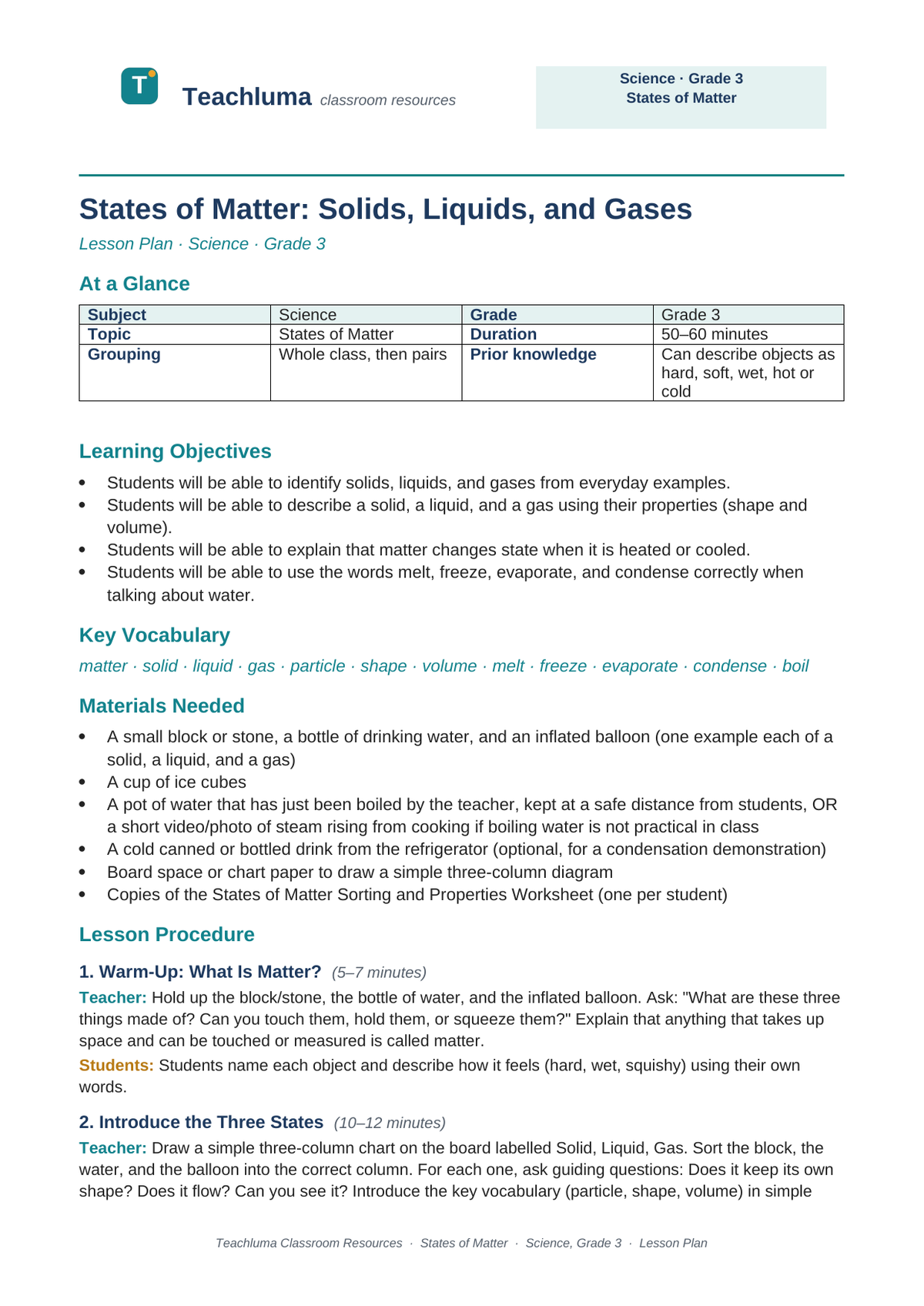
A complete, ready-to-teach lesson plan introducing Grade 3 students to the three states of matter. It walks a teacher through a warm-up, a hands-on demonstration using everyday items like ice and steam, guided and independent practice, and a closing activity, and pairs naturally with the States of Matter Sorting and Properties Worksheet. Written for classrooms across Southeast Asia, with materials and examples that don't rely on any one country's curriculum or seasons.

Overview

This lesson plan guides a teacher through a single 50–60 minute lesson on solids, liquids, and gases. It opens with a simple object-sorting warm-up, moves into a teacher-led demonstration of melting, evaporation, and condensation using safe, easy-to-find materials, and then hands over to guided and independent practice with the accompanying worksheet. The plan includes exact timing for each part of the lesson, sentence-level teacher and student actions, a three-level differentiation plan, and a short closing activity so students leave with the key vocabulary fresh in mind. A teacher reflection section at the end gives space to jot notes for next time.

Resource Details

Subject
Science
Topic
State of Matter
Category
Materials & Matter
File Type
PDF
File Size
76.9 KB
Published
07 Sep 2026
Downloads
0

Members Only

Upgrade to Teacher Pro (from ฿199/month) to download this resource.

Share:

Learning Objectives

  • Students will be able to identify solids, liquids, and gases from everyday examples.
  • Students will be able to describe a solid, a liquid, and a gas using their properties (shape and volume).
  • Students will be able to explain that matter changes state when it is heated or cooled.
  • Students will be able to use the words melt, freeze, evaporate, and condense correctly when talking about water.

Lesson Procedure

  • Read through the "At a Glance" and materials list the day before teaching so you can gather a stone or block, a bottle of water, an inflated balloon, a cup of ice, and access to hot water or a short video of steam. Follow the six numbered steps in order — warm-up, introduce the three states, demonstrate a change of state, then guided practice, independent practice, and closure. Students work as a whole class for the first half of the lesson, then move into pairs or independent work for the Sorting and Properties Worksheet referenced in Step 4 and 5. Use the differentiation table to adjust support on the spot, and the reflection space at the end to note what to change next time you teach it.

Assessment

Use the completed Sorting and Properties Worksheet from Step 4–5 as a formative check, and observe students during guided and independent practice using the criteria in the States of Matter Grading Rubric. The exit response in Step 6 gives a quick, informal check of who has picked up the new vocabulary.

Differentiation

Support: Provide a picture word bank showing solid, liquid, and gas next to a simple icon, offer sentence frames such as "The ___ is a ___ because it ___," and pair English language learners with a supportive partner.
On-level: Students complete the full worksheet independently, sorting all items and writing their own example sentence about a state change.
Challenge: Students add extra examples of their own, explain in writing why steam disappears when it cools on a mirror or window, or write directions for a partner to guess a mystery object's state.

Classroom Activity Ideas

  • "Freeze, Melt, Evaporate!" is a short movement game built into the lesson's closing minutes: call out a state change and have students act it out with their bodies, then play a few rounds calling changes in a different order each time.

Teacher Tips

In many Southeast Asian classrooms, ice and steam are easy to demonstrate safely using drinking water, a kettle, or a thermos of hot water rather than an open flame. If a live demonstration isn't possible, a short video clip of ice melting or rice being steamed works just as well to spark discussion.

What's Included

  • 3-page lesson plan (Word document)
  • Editable DOCX version
  • Print-ready PDF version

Additional Files

  • Grade 3 States of Matter Lesson Plan.docx

Teacher Reviews

No ratings yet

Be the first teacher to review this resource.

Sign in to review this resource.

Related Resources

Members Grade 3

Grade 3 States of Matter Sorting and Properties Worksheet

Worksheet · State of Matter

A four-part worksheet where students sort ten everyday items into solids, liquids, and gas...

View Resource
Members Grade 3

Grade 3 States of Matter Vocabulary and Concepts PowerPoint

PowerPoint · State of Matter

A 13-slide teaching presentation that introduces solids, liquids, and gases, walks through...

View Resource
Members Grade 2

Grade 2 Plants and How They Grow Lesson Plan

Lesson Plan · Plants and How They Grow

A complete 40–45 minute lesson plan introducing Grade 2 students to the main parts of a pl...

View Resource
Members Grade 2

Grade 2 Plants and How They Grow Review Quiz

Quiz · Plants and How They Grow

An 8-question review quiz covering the whole Plants and How They Grow topic, mixing multip...

View Resource
Free Grade 2

Grade 2 Plant Vocabulary Flashcards

Flashcards · Plants

A 12-word flashcard set covering plant parts (seed, roots, stem, leaf, flower, fruit) and ...

View Resource
Free Grade 2

Grade 2 What Plants Need to Grow Reading Activity

Reading Activity · What Plants Need to Grow

A short reading passage, "A School Garden," about two students caring for a school garden,...

View Resource

Advertisement