Grade 6 Force and Friction Investigation Activity
Free Science Classroom Activity Grade 6
No ratings yet

Grade 6 Force and Friction Investigation Activity

About This Resource

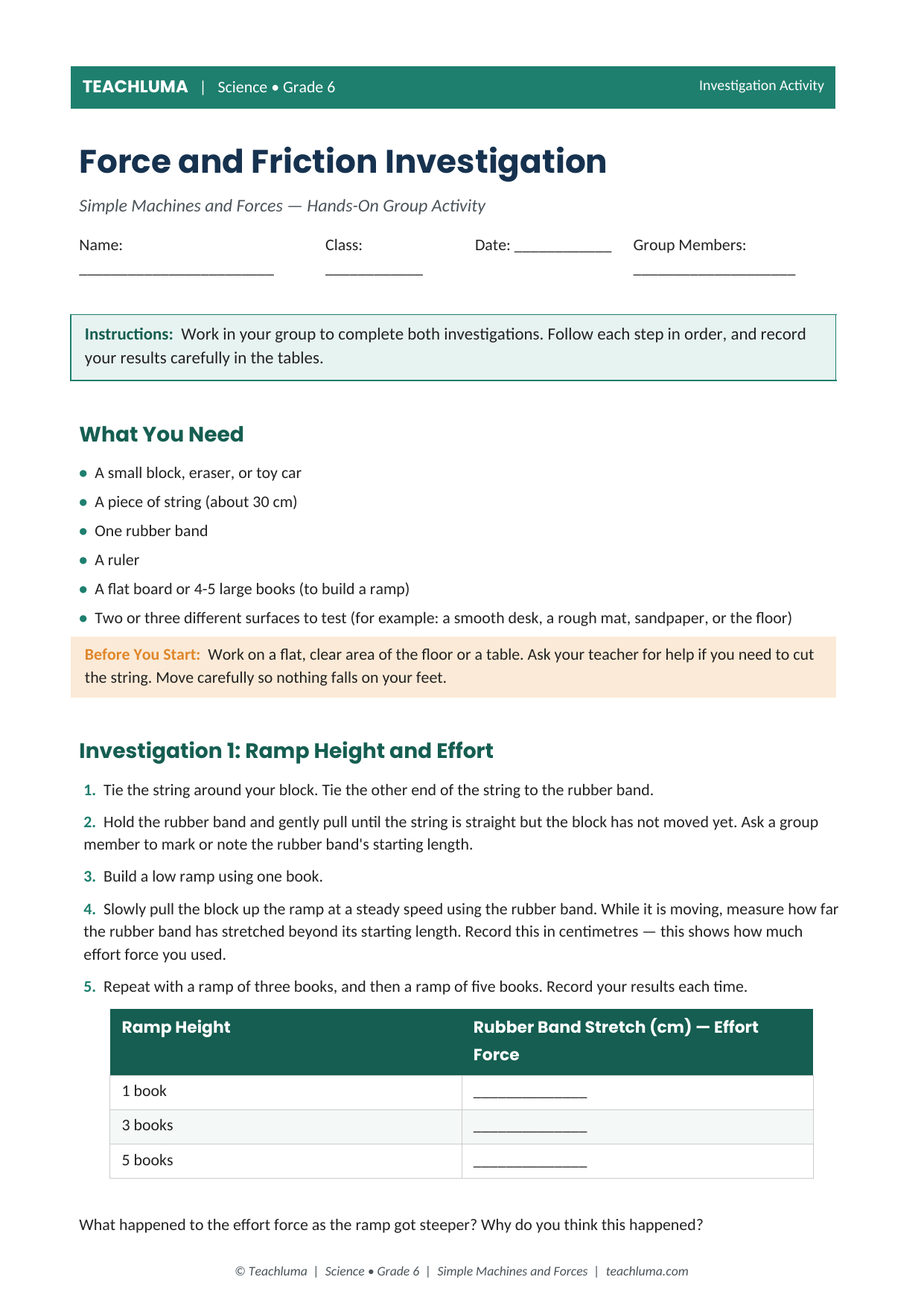
A hands-on, low-resource group investigation where Grade 6 students use a block, string, and a rubber band to measure how effort force changes on a ramp and how friction changes across different surfaces. Everything needed can be found in almost any classroom or home.

Overview

Students build a simple ramp from books, then use a rubber band as a basic force gauge — the more the rubber band stretches while pulling a block, the more effort force is being used. In Investigation 1, groups test how effort force changes as the ramp gets steeper. In Investigation 2, groups compare how much effort is needed to drag the same block across two or three different surfaces, connecting the results to friction. The activity finishes with a short written conclusion and a "Think Like a Scientist" prediction question. Because no special science equipment is required, this investigation works equally well in a well-equipped lab or a classroom with no lab at all.

Resource Details

Subject
Science
Topic
Force and Friction
Category
Forces & Energy
File Type
PDF
File Size
54.1 KB
Published
07 Sep 2026
Downloads
0
Download

Free download — no account required.

Teaching this in class? Try our free Random Name Picker & Timer.

Share:

How to Play

  • Prepare materials in advance: one small block or toy car, string, a rubber band, a ruler, several large books, and two or three surfaces to test per group (a desk, a mat, sandpaper, or the floor all work). Demonstrate the pulling technique once for the whole class before groups begin, so everyone measures consistently. Groups of three or four work well — one student can pull, one can watch the rubber band, one can measure, and one can record results. Circulate during both investigations to check that groups are pulling at a steady, slow speed, since a jerky pull gives an unreliable reading.

Variations

  • Fair Test Challenge: after both investigations, ask groups to list everything they kept the same between tests (same block, same rubber band, same pulling speed) and everything that changed (ramp height, or surface). Discuss as a class why keeping some things the same makes the test fair.

Teacher Tips

Test the investigation yourself before class with your own ramp and surfaces, so you know roughly what students should observe — this makes it much easier to help a group whose results do not match the expected pattern.

Learning Objectives

  • Students will be able to use a simple tool to compare the size of a force.
  • Students will be able to describe how effort force changes as a ramp becomes steeper.
  • Students will be able to compare the friction of different surfaces based on measured results.
  • Students will be able to record observations in a table and draw a conclusion from their data.
  • Students will be able to explain which simple machine their investigation used.

Differentiation

SUPPORT: Assign clear group roles (puller, watcher, measurer, recorder) so each student has one manageable job, provide a partly filled example row in the results table as a model, and allow spoken rather than written conclusions for students who need it.
ON-LEVEL: Complete both investigations and result tables independently within groups, writing a full conclusion in "What I Found Out."
CHALLENGE: Complete the "Think Like a Scientist" prediction and test it with a heavier object if time and materials allow, then compare the result to their prediction.

Assessment

Completed recording sheet, teacher observation of group work during both investigations, and the written conclusion in "What I Found Out."

What's Included

  • 2-page student recording sheet with materials list, step-by-step instructions, and result tables
  • Editable DOCX version
  • Print-ready PDF version
  • Teacher notes with expected results, discussion prompts, and safety notes (in place of a fixed-answer key, since measurements will vary)

Additional Files


Teacher Reviews

No ratings yet

Be the first teacher to review this resource.

Sign in to review this resource.

Related Resources

Members Grade 6

Grade 6 Simple Machines and Forces Grading Rubric
Grading Rubric · Simple Machines and Forces

A four-level grading rubric for assessing Grade 6 student understanding of forces and simp...

View Resource
Free Grade 6

Grade 6 Simple Machines and Forces Teacher's Guide

Teacher Resource · Simple Machines and Forces

A background reading guide for teachers delivering this topic, covering the science behind...

View Resource
Members Grade 6

Grade 6 Simple Machines and Forces Quiz

Quiz · Simple Machines and Forces

A 24-point summative quiz covering force, friction, gravity, and the six simple machines, ...

View Resource
Members Grade 6

Grade 6 Spot the Simple Machine Review Activity

Game · Simple Machine Review

A whole-class bingo review game where Grade 6 students build their own unique bingo card b...

View Resource
Members Grade 6

Grade 6 Six Simple Machines Classification Worksheet

Worksheet · Simple Machines Classification

A two-page worksheet where Grade 6 students match definitions to the six simple machines, ...

View Resource
Free Grade 6

Grade 6 Simple Machines Reading Comprehension Activity

Reading Activity · Simple Machines and Forces

A two-page reading passage about a family's busy market day, where Grade 6 students meet a...

View Resource

Advertisement