Grade 6 Simple Machines and Forces Grading Rubric
A four-level grading rubric for assessing Grade 6 student understanding of forces and simp...
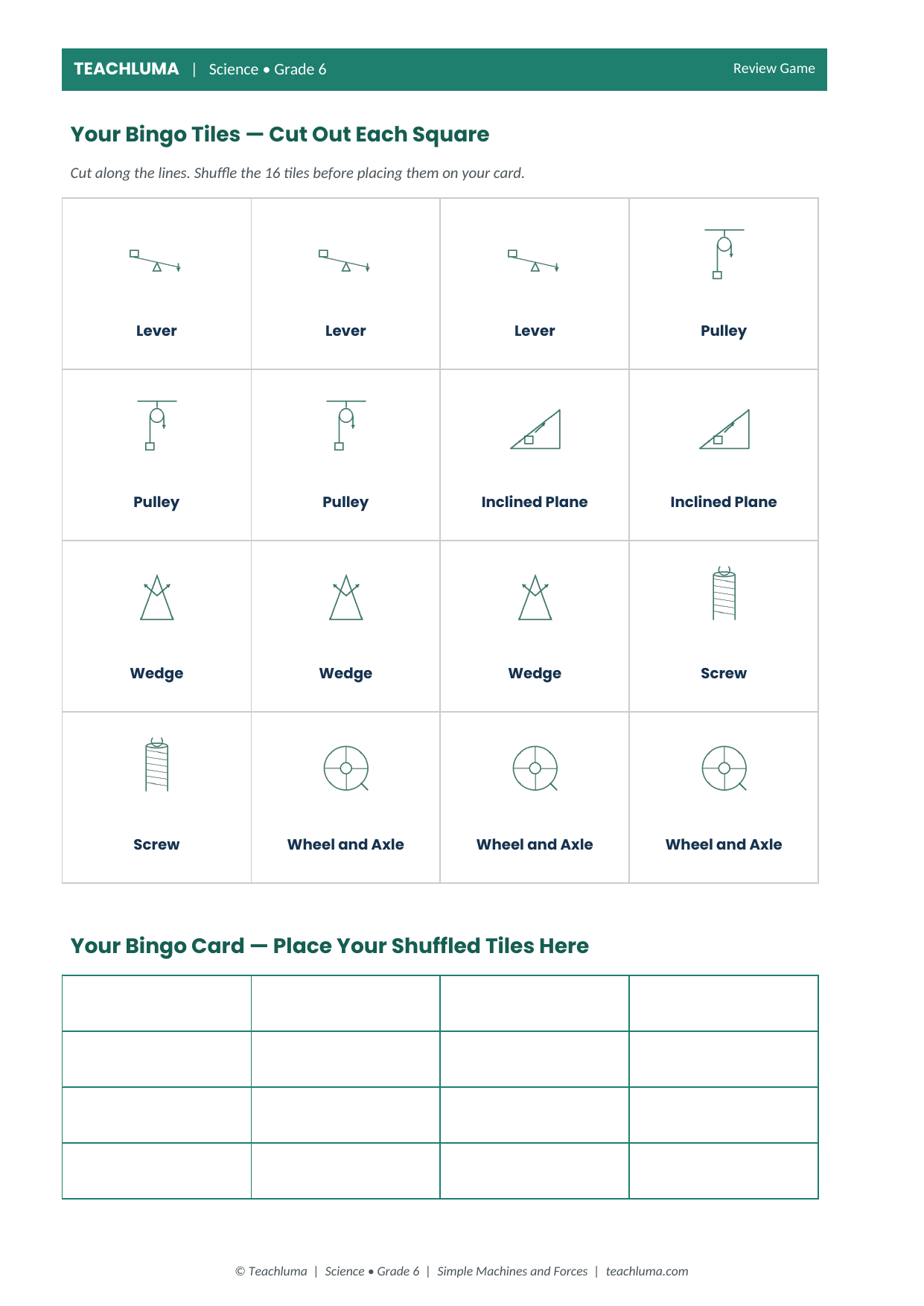
View Resource : Grade 6 Simple Machines and Forces Grading RubricA whole-class bingo review game where Grade 6 students build their own unique bingo card by cutting out and shuffling 16 simple-machine tiles, then mark their card as the teacher reads out 20 real-life examples. A fun, low-prep way to review the whole topic before a quiz.
Instead of a single fixed bingo card, students cut out 16 tiles (each showing one of the six simple machines with a small original icon), shuffle them, and place them onto a blank 4-by-4 grid in their own order — so every student's card is different using just one printed page. The teacher then reads real-life examples from a 20-item call list in any order (a pair of pliers cracking a nut, a mountain road that zigzags up a hill, a drill bit turning into a wall, and more), and students mark the matching simple machine on their card. The first student with four in a row calls "Bingo!" and has to explain which examples matched their squares, which keeps the reasoning — not just luck — part of winning.
Members Only
Upgrade to Teacher Pro (from ฿199/month) to download this resource.
Only need a few resources, not a full subscription? This one's also included in:
Grade 6 Simple Machines and Forces — Complete Topic Bundle — ฿99 one-timeLooking for something different? Request a Resource.
Cut a few call list items into strips and draw them from a bag or box instead of reading straight down the list — it adds suspense and makes sure the order is different every time you play.
SUPPORT: Let students keep the word bank of six simple machines visible during play, pair students together to share one card, and allow students to point to or say the machine name rather than write anything.
ON-LEVEL: Build an individual card and play independently, explaining each winning match in a full sentence.
CHALLENGE: After winning, challenge the student to give one additional real-life example (not on the call list) for each of their four winning squares.
Teacher observation of how confidently and accurately students match examples to machines, and listening to student explanations when they call "Bingo!"
No ratings yet
Be the first teacher to review this resource.
A four-level grading rubric for assessing Grade 6 student understanding of forces and simp...
View Resource : Grade 6 Simple Machines and Forces Grading RubricA background reading guide for teachers delivering this topic, covering the science behind...
View Resource : Grade 6 Simple Machines and Forces Teacher's GuideA 24-point summative quiz covering force, friction, gravity, and the six simple machines, ...
View Resource : Grade 6 Simple Machines and Forces QuizA hands-on, low-resource group investigation where Grade 6 students use a block, string, a...
View Resource : Grade 6 Force and Friction Investigation ActivityA two-page worksheet where Grade 6 students match definitions to the six simple machines, ...
View Resource : Grade 6 Six Simple Machines Classification WorksheetA two-page reading passage about a family's busy market day, where Grade 6 students meet a...
View Resource : Grade 6 Simple Machines Reading Comprehension ActivityAdvertisement