Grade 6 Simple Machines and Forces Lesson Plan
Members Only Science Lesson Plan Grade 6
No ratings yet

Grade 6 Simple Machines and Forces Lesson Plan

About This Resource

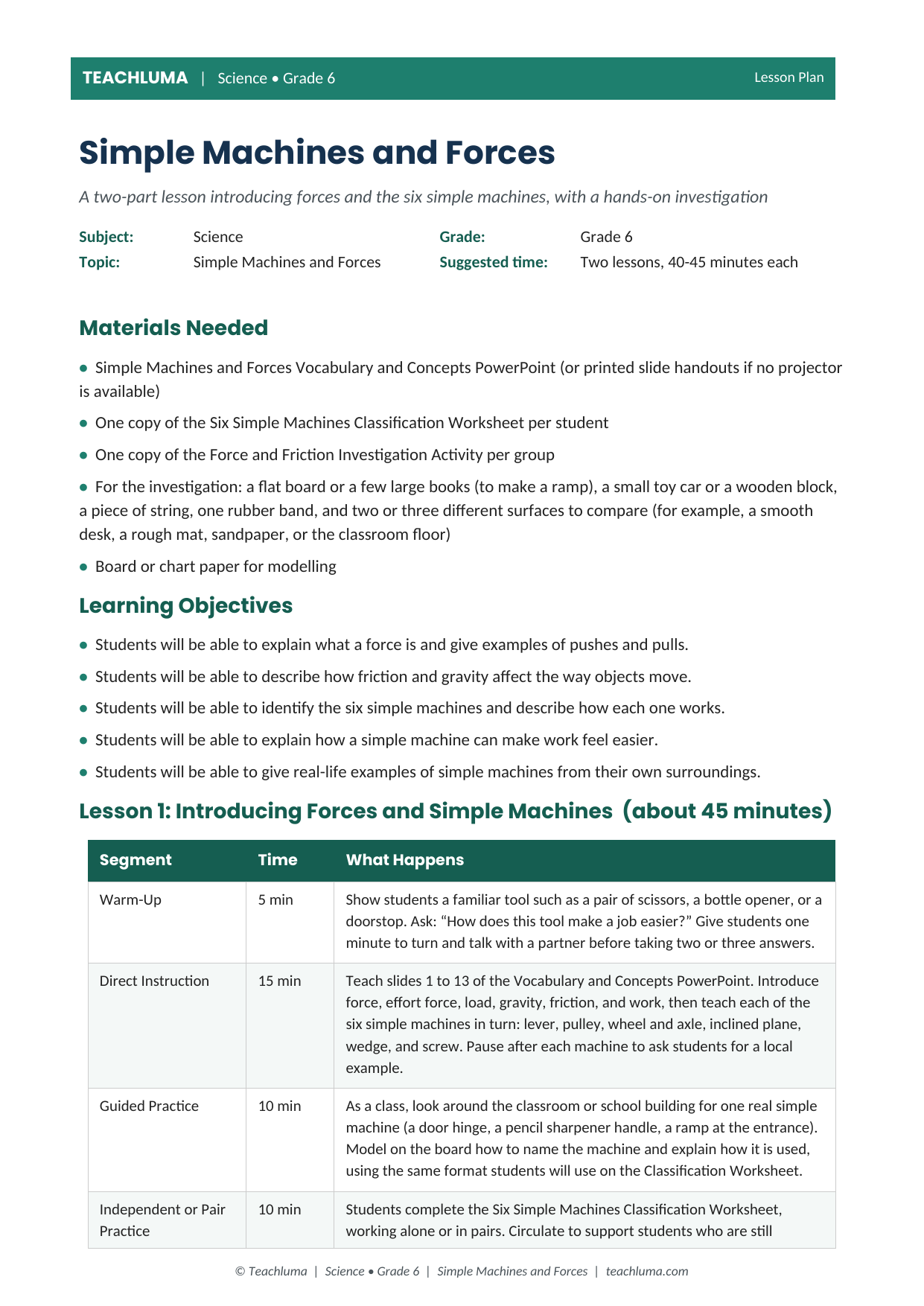
A two-lesson plan (about 40-45 minutes each) that introduces Grade 6 students to force, friction, and gravity, teaches the six simple machines, and leads into a hands-on investigation comparing effort and friction. Written with simple, clear teacher language and low-resource classroom materials in mind.

Overview

This lesson plan sets out a full teaching sequence across two lessons. Lesson 1 introduces force vocabulary and all six simple machines using the Vocabulary and Concepts PowerPoint, then moves into guided and independent practice with the Classification Worksheet. Lesson 2 opens with a short friction demonstration and leads into a small-group investigation comparing effort on a ramp and friction across different surfaces, using materials most classrooms already have. The plan includes timing for every segment, a note on where the other resources in this collection fit, differentiation at three levels, common misconceptions to watch for, and an extension idea for early finishers.

Resource Details

Subject
Science
Topic
Simple Machines and Forces
Category
Forces & Energy
File Type
PDF
File Size
68.3 KB
Published
07 Sep 2026
Downloads
0

Members Only

Upgrade to Teacher Pro (from ฿199/month) to download this resource.

Share:

Grade 40-45 Minutes Lesson Plan Simple Machines and Forces

Learning Objectives

  • Students will be able to explain what a force is and give examples of pushes and pulls.
  • Students will be able to describe how friction and gravity affect the way objects move.
  • Students will be able to identify the six simple machines and describe how each one works.
  • Students will be able to explain how a simple machine can make work feel easier.
  • Students will be able to give real-life examples of simple machines from their own surroundings.

Lesson Procedure

  • Read through both lessons before teaching, and gather the investigation materials in advance — a flat board or a few large books for a ramp, a small toy car or block, string, a rubber band, and two or three surfaces to compare. Teach Lesson 1 and Lesson 2 in separate class periods, or combine them into one longer session if your school has an extended science block. The PowerPoint, Classification Worksheet, and Investigation Activity referenced in this plan are separate resources in this collection and should be prepared ahead of time.

Assessment

Teacher observation during guided practice and the group investigation, review of the completed Classification Worksheet and Investigation Activity, listening for correct vocabulary use during discussion, and the exit ticket at the end of Lesson 2. The Grading Rubric in this collection can be applied once students have work from the Classification Worksheet, Investigation Activity, and Quiz.

Differentiation

SUPPORT: Provide a printed word bank with a small icon next to each simple machine, allow students to point to and copy words rather than write from memory, pair students with a partner who can help translate a difficult term, and reduce the Classification Worksheet to the four most familiar machines if needed.
ON-LEVEL: Complete the Classification Worksheet and Investigation Activity as designed, using full sentences to explain each answer.
CHALLENGE: Find a compound machine (a tool made of two or more simple machines, such as scissors or a bicycle) and explain which simple machines it combines and how.

Classroom Activity Ideas

  • Machine Hunt: after Lesson 1, ask students to find one simple machine at home or on the way to school and be ready to describe it the next day — what it is, which simple machine it uses, and what job it helps with.

Teacher Tips

Machine Hunt: after Lesson 1, ask students to find one simple machine at home or on the way to school and be ready to describe it the next day — what it is, which simple machine it uses, and what job it helps with.

What's Included

  • Full two-lesson plan document, including timing, teacher instructions, and discussion questions
  • Editable DOCX version
  • Print-ready PDF version

Additional Files

  • Grade 6 Simple Machines and Forces Lesson Plan.docx

Teacher Reviews

No ratings yet

Be the first teacher to review this resource.

Sign in to review this resource.

Related Resources

Members Grade 6

Grade 6 Simple Machines and Forces Quiz

Quiz · Simple Machines and Forces

A 24-point summative quiz covering force, friction, gravity, and the six simple machines, ...

View Resource
Members Grade 6

Grade 6 Spot the Simple Machine Review Activity

Game · Simple Machine Review

A whole-class bingo review game where Grade 6 students build their own unique bingo card b...

View Resource
Free Grade 6

Grade 6 Force and Friction Investigation Activity

Classroom Activity · Force and Friction

A hands-on, low-resource group investigation where Grade 6 students use a block, string, a...

View Resource
Members Grade 6

Grade 6 Six Simple Machines Classification Worksheet

Worksheet · Simple Machines Classification

A two-page worksheet where Grade 6 students match definitions to the six simple machines, ...

View Resource
Free Grade 6

Grade 6 Simple Machines Reading Comprehension Activity

Reading Activity · Simple Machines and Forces

A two-page reading passage about a family's busy market day, where Grade 6 students meet a...

View Resource
Members Grade 6

Grade 6 Simple Machines and Forces Vocabulary and Concepts PowerPoint

PowerPoint · Simple Machines and Forces

A 17-slide PowerPoint that introduces Grade 6 students to force, friction, and gravity, th...

View Resource

Advertisement