Grade 6 Simple Machines and Forces Grading Rubric
A four-level grading rubric for assessing Grade 6 student understanding of forces and simp...
View Resource : Grade 6 Simple Machines and Forces Grading RubricA 17-slide PowerPoint that introduces Grade 6 students to force, friction, and gravity, then walks through all six simple machines — lever, pulley, wheel and axle, inclined plane, wedge, and screw. Built for classrooms where English is not every student's first language, with short sentences, a labelled diagram slide, and clear example sentences for every term.
This presentation opens with the lesson's learning objectives, then teaches core force vocabulary (force, effort force, load, gravity, friction, work) before moving through each of the six simple machines one at a time — a plain-language definition, a simple original diagram, and a real example sentence set in a Southeast Asian context (a market cart, a village well, a ramp for loading a motorbike). A "Look and Learn" slide brings all six machines together on one labelled diagram, a "Spot the Machine" slide gives students a quick picture-based check, and the closing slides point students to the classification worksheet and review the lesson's main ideas.
Free download — no account required.
Teaching this in class? Try our free Random Name Picker & Timer.
Looking for something different? Request a Resource.
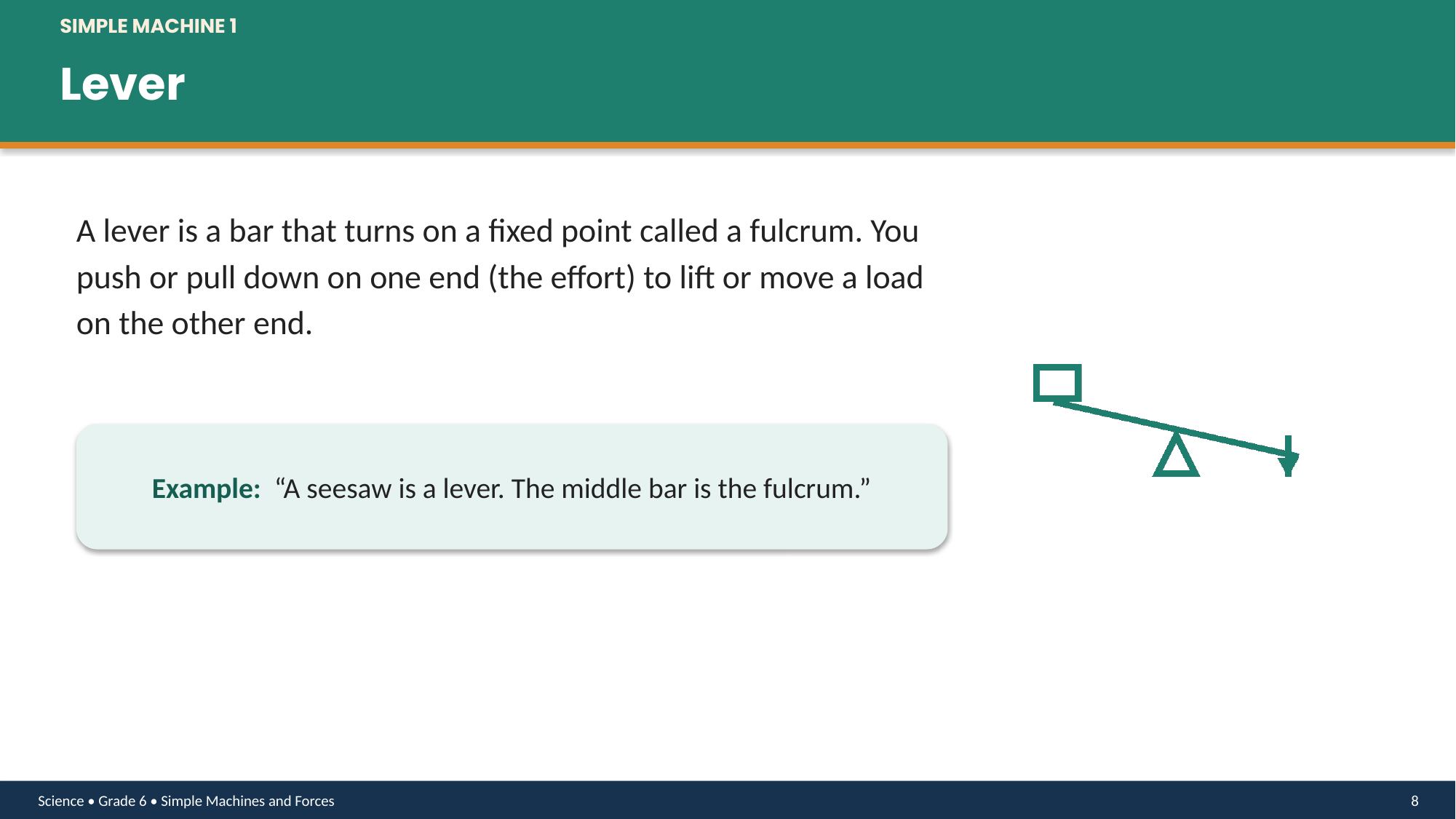
Before teaching the lever, pulley, and wheel and axle slides, bring in (or show a photo of) one real object from your own school or town that uses that machine — a well winch, a wheelbarrow, or a bicycle work well almost anywhere in the region — so the diagram is immediately connected to something students already know.
SUPPORT: Point to the diagram on each slide while reading the definition aloud, allow students to repeat key words chorally before writing anything, and pair students with a partner who can help translate a difficult term.
ON-LEVEL: Follow along with the slides and give one original spoken example for each simple machine when asked.
CHALLENGE: Before the "Look and Learn" slide, ask students to predict which of the six machines is used in a tool they choose themselves, then explain their reasoning to a partner.
Teacher observation during the "Spot the Machine" slide, listening for correct vocabulary use when students suggest their own examples, and a quick show-of-hands check during the review slide before moving on to the worksheet.
No ratings yet
Be the first teacher to review this resource.
A four-level grading rubric for assessing Grade 6 student understanding of forces and simp...
View Resource : Grade 6 Simple Machines and Forces Grading RubricA background reading guide for teachers delivering this topic, covering the science behind...
View Resource : Grade 6 Simple Machines and Forces Teacher's GuideA 24-point summative quiz covering force, friction, gravity, and the six simple machines, ...
View Resource : Grade 6 Simple Machines and Forces QuizA whole-class bingo review game where Grade 6 students build their own unique bingo card b...
View Resource : Grade 6 Spot the Simple Machine Review ActivityA hands-on, low-resource group investigation where Grade 6 students use a block, string, a...
View Resource : Grade 6 Force and Friction Investigation ActivityA two-page worksheet where Grade 6 students match definitions to the six simple machines, ...
View Resource : Grade 6 Six Simple Machines Classification WorksheetAdvertisement