Skip to content
Preview
Members Only Science Complete Lesson Pack Grade 2 (Year 3)
No ratings yet

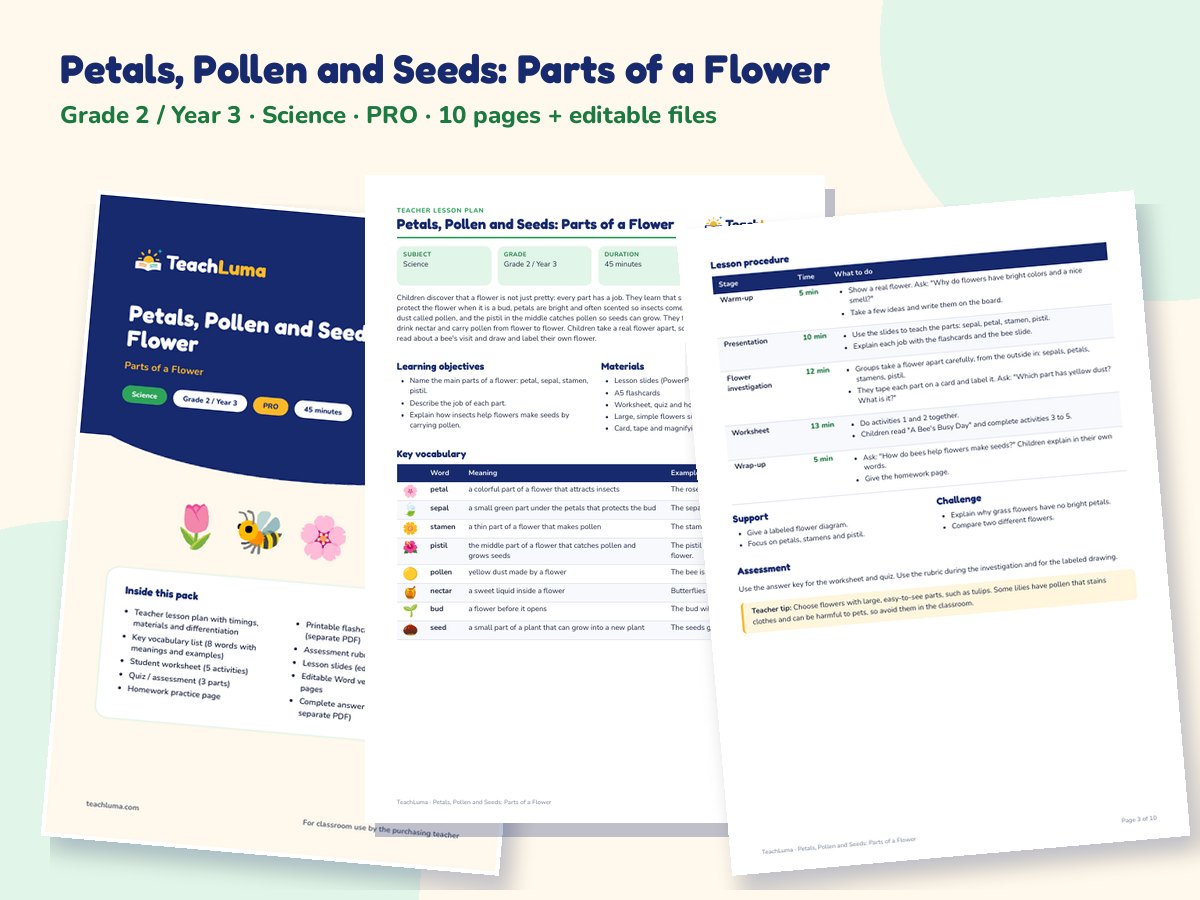
Petals, Pollen and Seeds: Parts of a Flower

About This Resource

A complete Grade 2 science pack on the parts of a flower and their jobs: colorful petals that attract insects, green sepals that protect the bud, stamens that make pollen, the pistil that catches pollen and grows the seeds, and sweet nectar that feeds bees and butterflies. Children look closely at a real flower, match each part to its job and order the steps from flower to seed.

Overview

Children discover that a flower is not just pretty: every part has a job. They learn that sepals are small green leaves that protect the flower when it is a bud, petals are bright and often scented so insects come to visit, stamens make a yellow dust called pollen, and the pistil in the middle catches pollen so seeds can grow. They find out how bees and butterflies drink nectar and carry pollen from flower to flower. Children take a real flower apart, sort its parts, match parts to jobs, read about a bee's visit and draw and label their own flower.

Resource Details

Subject
Science
Topic
Parts of a Flower
Category
Plants
File Type
PDF
File Size
346.5 KB
Published
08 Nov 2026
Downloads
0

Members Only

Upgrade to Teacher Pro (from ฿199/month) to download this resource.

Share:

Looking for something different? Request a Resource.

Grade 2 (ages 7–8) 45 minutes Life science observing labeling sequencing explaining

Learning Objectives

  • Name the main parts of a flower: petal, sepal, stamen, pistil.
  • Describe the job of each part.
  • Explain how insects help flowers make seeds by carrying pollen.

How to Use This Resource

  • Start with slide 1: show a real flower and ask, "Why do flowers have bright colors?"
  • Teach the parts and their jobs with the slides and flashcards, then take a flower apart together and do worksheet activities 1 and 2.
  • Children complete activities 3 to 5, then use the quiz and send the homework page home.

Classroom Activity Ideas

  • Flower dissection: give each group a large, simple flower (a tulip works well) to take apart with fingers or tweezers. They stick each part on a card and label it.
  • Bee role-play: one child is a bee with a pipe cleaner "tongue"; they visit paper flowers dusted with chalk "pollen" and see how it moves between flowers.
  • Seed search: open a tomato, apple or pea pod to show where seeds grow after a flower is pollinated.

Differentiation

Support: give a labeled flower diagram with pictures for each job, and focus on petals, stamens and pistil. Challenge: explain why flowers that are pollinated by the wind, such as grasses, often have small, dull petals.

Assessment

Use the worksheet and quiz to check names and jobs of the parts. Use the rubric during the flower dissection and the labeled drawing.

Teacher Tips

Choose flowers with large, easy-to-see parts, such as tulips. Some lilies have pollen that stains clothes and can be harmful to pets, so avoid them in the classroom.

What's Included

  • 10-page printable PDF lesson pack: teacher lesson plan with timings, materials and differentiation
  • Key vocabulary list (8 words with meanings and examples)
  • Student worksheet (5 activities)
  • Quiz / assessment (3 parts)
  • Homework practice page
  • Printable flashcards: 8 A5 picture cards (separate PDF)
  • Assessment rubric (4 levels)
  • Lesson slides (editable PowerPoint)
  • Editable Word version of all student pages
  • Complete answer key (also as a separate PDF)

Additional Files

  • Lesson Slides (PPTX)
  • Editable Student Pages and Lesson Plan (DOCX)
  • A5 Flashcards (PDF)
  • Answer Key (PDF)

Teacher Reviews

No ratings yet

Be the first teacher to review this resource.

Sign in to review this resource.

Related Resources

Advertisement