Skip to content
Preview
Members Only Science Complete Lesson Pack Grade 4 (Year 5)
No ratings yet

Slowing Down: Air Resistance and Water Resistance

About This Resource

A complete Grade 4 science pack on air resistance and water resistance. Students learn that these forces push against moving objects and slow them down, test parachutes of different sizes, compare shapes moving through water, explain streamlining in animals and vehicles and plan a fair test. Includes slides, a lesson plan, worksheet, quiz, homework, flashcards, a rubric and answer keys.

Overview

When an object moves through air or water, the air or water pushes against it. These pushing forces are called air resistance and water resistance, and they act in the opposite direction to the movement, slowing the object down. A large surface area catches more air, which is why parachutes work. Streamlined shapes, which are smooth and pointed, cut through air and water more easily, which is why fish, dolphins, racing cyclists and airplanes have them. Students carry out a parachute investigation, change one variable at a time, measure fall times, compare shapes of modeling clay sinking in water and explain their results using force arrows.

Resource Details

Subject
Science
Topic
Air Resistance and Water Resistance
Category
Forces & Energy
File Type
PDF
File Size
308.2 KB
Published
13 Nov 2026
Downloads
0

Members Only

Create a free account to download this resource with one of your 3 Free Pro Previews, or upgrade to Teacher Pro (from ฿199/month) for the whole library.

Share:

Looking for something different? Request a Resource.

Grade 4 science (ages 9–10) 60 minutes Physical science fair testing measuring explaining with force diagrams

Learning Objectives

  • Explain that air resistance and water resistance slow moving objects.
  • Describe how surface area and shape affect resistance.
  • Plan and carry out a fair test with one changed variable.

How to Use This Resource

  • Show the slides: drop a flat sheet of paper and a scrunched ball of paper at the same time. Ask: "Why did one fall more slowly?"
  • Teach the forces with force arrows, then do worksheet activities 1 and 2 together.
  • Students complete the parachute investigation and activities 3 to 6, then use the quiz and send the homework page home.

Classroom Activity Ideas

  • Paper drop: compare a flat sheet and a scrunched ball dropped from the same height.
  • Parachute test: groups test parachutes with different canopy sizes and time the fall.
  • Clay shapes: students drop clay shapes into tall containers of water and compare how fast they sink.

Differentiation

Support: give a results table and focus on comparing two parachute sizes. Challenge: students calculate the average of three times and explain anomalies.

Assessment

Use the worksheet and quiz to check understanding of the forces. Use the rubric to assess the investigation and explanations.

Teacher Tips

Use a stopwatch and repeat each drop three times to get reliable results. Students should change only one thing, such as the canopy size, and keep the height, load and material the same. Drop parachutes from a safe height, such as standing on the floor with an arm raised, not from furniture.

What's Included

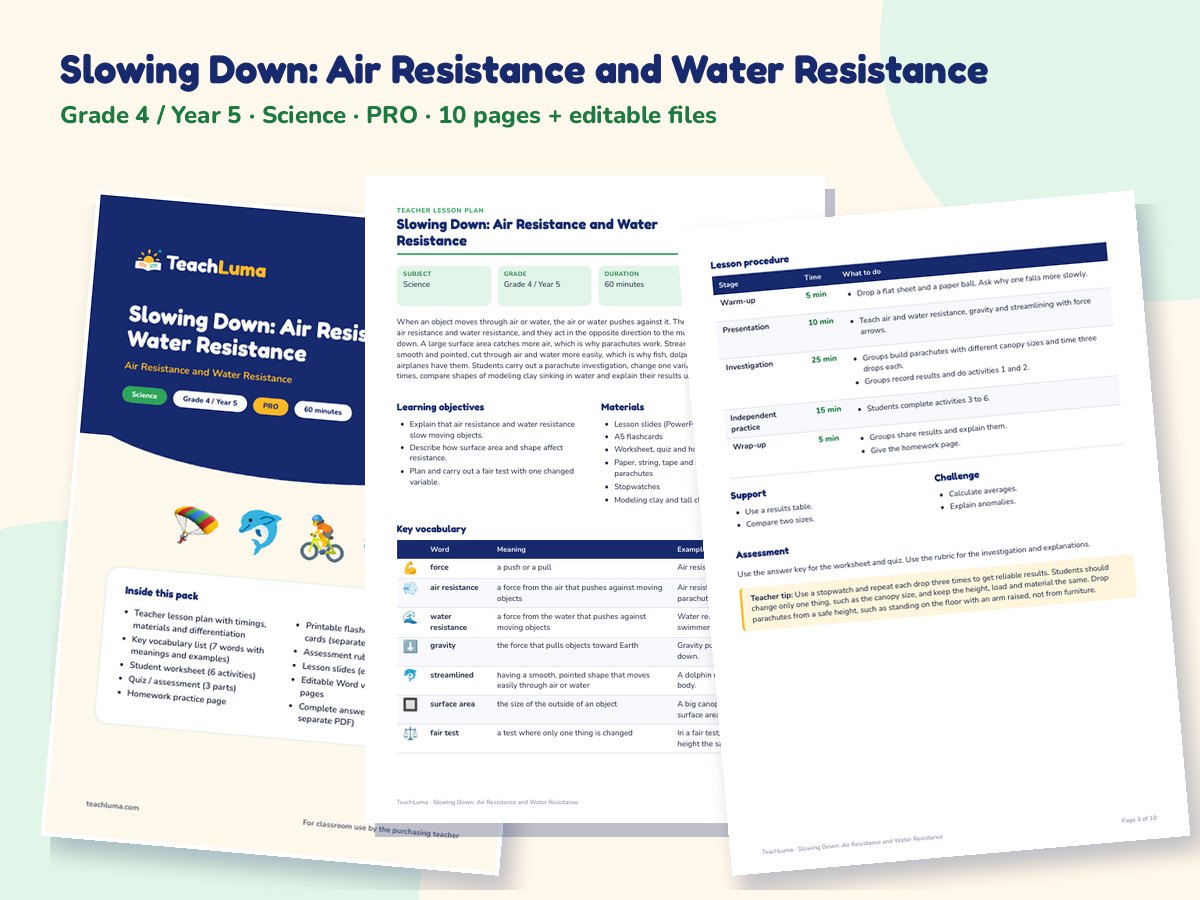
  • 10-page printable PDF lesson pack: teacher lesson plan with timings, materials and differentiation
  • Key vocabulary list (7 words with meanings and examples)
  • Student worksheet (6 activities)
  • Quiz / assessment (3 parts)
  • Homework practice page
  • Printable flashcards: 7 A5 picture cards (separate PDF)
  • Assessment rubric (4 levels)
  • Lesson slides (editable PowerPoint)
  • Editable Word version of all student pages
  • Complete answer key (also as a separate PDF)

Additional Files

  • Lesson Slides (PPTX)
  • Editable Student Pages and Lesson Plan (DOCX)
  • A5 Flashcards (PDF)
  • Answer Key (PDF)

Teacher Reviews

No ratings yet

Be the first teacher to review this resource.

Sign in to review this resource.

Related Resources

Advertisement