Grade 3 Multiplication Facts and Arrays Grading Rubric
A five-criteria rubric for assessing student understanding of arrays and multiplication fa...
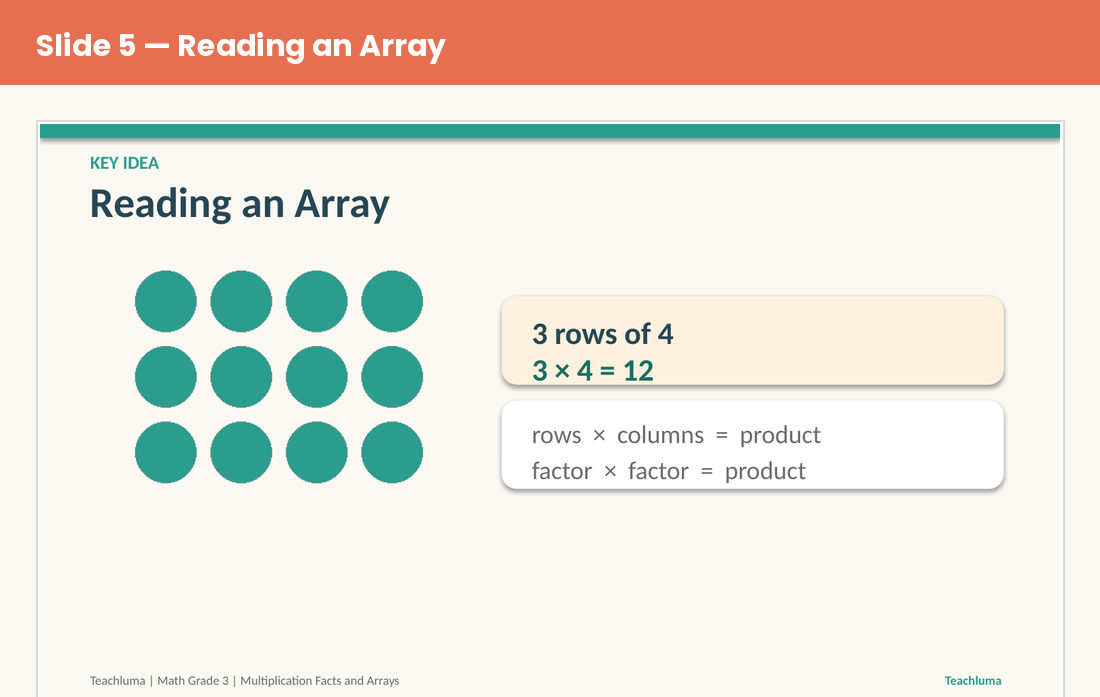
View Resource : Grade 3 Multiplication Facts and Arrays Grading RubricAn 11-slide PowerPoint that introduces arrays, rows and columns, and multiplication sentences for a Grade 3 Math class. It moves from the basic vocabulary through worked examples and guided practice to a review, using clear dot and object arrays throughout so students can see the concept, not just read about it.
This presentation is designed to run alongside the Multiplication Facts and Arrays Lesson Plan's Presentation and Guided Practice sections. It opens by defining what an array is, then builds up the vocabulary — row, column, factor, product — one idea at a time before connecting arrays to repeated addition and finally to the multiplication sentence itself. A teacher-modelling dialogue slide shows the kind of questioning a teacher can use with students, and a guided practice slide gives two arrays for students to build and solve together before an independent-style review slide closes out the deck.
Free download — no account required.
Teaching this in class? Try our free Random Name Picker & Timer.
Looking for something different? Request a Resource.
When you get to the "Multiplication Is Repeated Addition" slide, resist moving on too quickly — this is the slide that does the most work in connecting a concept students may already sense intuitively (equal groups) to the more abstract idea of multiplication. A slower pace here often pays off for the rest of the topic.
SUPPORT: Pause on the "Reading an Array" and "Rows and Columns" slides for longer, and have students point to and count the rows and columns themselves as you display the array, rather than only watching.
ON-LEVEL: Follow the presentation at its designed pace, participating fully in the Teacher Model and Guided Practice slides.
CHALLENGE: During the Guided Practice slide, ask early finishers to also write the multiplication sentence in the reverse order (for example, both 3 × 4 and 4 × 3) and explain why both give the same product.
Use the Guided Practice and Review slides as informal checks — ask students to respond chorally or on mini whiteboards with the multiplication sentence for each array shown. For a more formal check, follow this presentation with the Multiplication Facts and Arrays Quiz.
No ratings yet
Be the first teacher to review this resource.
A five-criteria rubric for assessing student understanding of arrays and multiplication fa...
View Resource : Grade 3 Multiplication Facts and Arrays Grading RubricA set of 12 print-ready flashcards for practising multiplication facts, spanning the 2, 3,...
View Resource : Grade 3 Multiplication Facts FlashcardsA three-page word problem worksheet that sets multiplication and array problems in everyda...
View Resource : Grade 3 Multiplication Word Problem WorksheetA two-page fact-fluency worksheet covering skip counting, solving 2s, 5s, and 10s facts, a...
View Resource : Grade 3 Multiplication Facts Practice WorksheetA four-page hands-on worksheet where Grade 3 students read arrays, draw their own, match a...
View Resource : Grade 3 Arrays Worksheet: Read, Draw, and MatchA complete 40–45 minute lesson that introduces arrays as a way of understanding multiplica...
View Resource : Grade 3 Multiplication Facts and Arrays Lesson PlanAdvertisement