Grade 3
40-45 Minutes
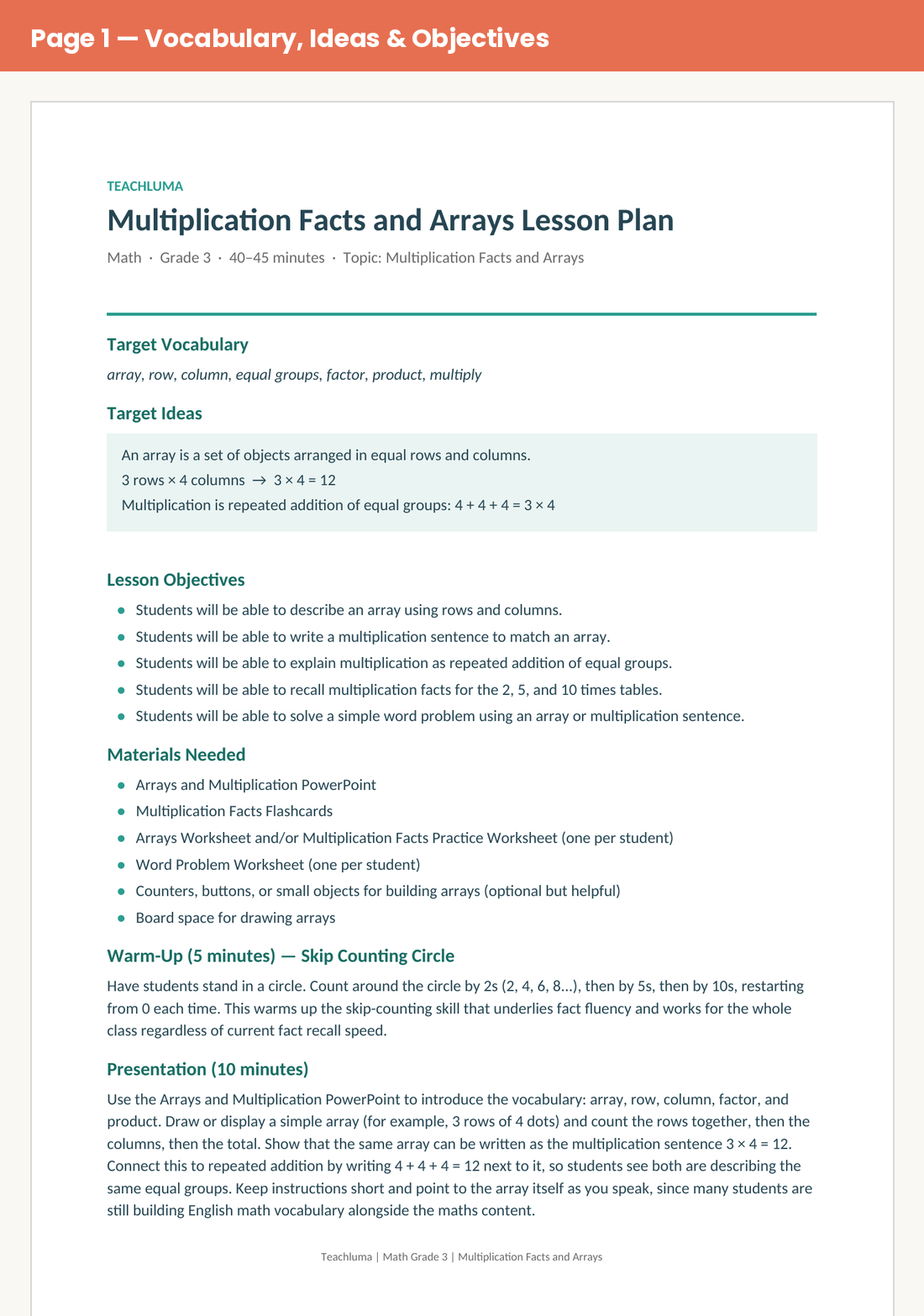
Multiplication Facts and Arrays
Lesson Plan
Learning Objectives
- Students will be able to describe an array using rows and columns.
- Students will be able to write a multiplication sentence to match an array.
- Students will be able to explain multiplication as repeated addition of equal groups.
- Students will be able to recall multiplication facts for the 2, 5, and 10 times tables.
- Students will be able to solve a simple word problem using an array or multiplication sentence.
Lesson Procedure
- Read through the lesson plan before class and gather counters, buttons, or small objects for the guided practice section — real objects work better than pictures alone for first introducing the array concept. Use the Arrays and Multiplication PowerPoint alongside the Presentation section to introduce the vocabulary. During Guided Practice, circulate as small groups build arrays with counters, checking that each group has the correct number of rows and columns before calling out the next fact. For Independent Practice and Production, hand out the Arrays Worksheet, Multiplication Facts Practice Worksheet, and Word Problem Worksheet as described in the plan. Review completed work using the Grading Rubric where a closer look is useful.
Assessment
Use the Wrap-Up section's choral response check as an informal, in-the-moment gauge of understanding, and the Multiplication Facts and Arrays Quiz as a short formal check either at the end of this lesson or the start of the next. For a closer look at a student's reasoning on the Word Problem Worksheet or Arrays Worksheet, use the Grading Rubric.
Differentiation
SUPPORT: Provide physical counters for every array task, and limit fact practice to the 2 and 5 times tables until those are secure. Keep a rows-x-columns sentence frame visible on the board ("___ rows of ___ = ___") so students always have language support alongside the maths.
ON-LEVEL: Students build, draw, and write multiplication sentences for arrays independently, and complete the Word Problem Worksheet with the standard fact range (2, 5, and 10 times tables).
CHALLENGE: Introduce larger arrays (up to 10 rows or columns) and facts beyond the 2, 5, and 10 times tables. Ask students to write a second word problem of their own to match a given array.
Classroom Activity Ideas
- Split the class into pairs and give each pair a set of counters. One partner calls out a rows-by-columns fact (for example, "4 rows of 3"), and the other builds it with counters and says the multiplication sentence aloud. Partners swap roles after five rounds. This keeps the link between the physical array and the spoken sentence active well after the main lesson.
Teacher Tips
Keep a physical or drawn array visible on the board any time you introduce a new fact during this lesson, even once students seem comfortable with the abstract sentence. Students who look confident with "3 × 4 = 12" in isolation often lose that confidence the moment the numbers change — pointing back to the array keeps the reasoning, not just the answer, in view.
Additional Files
-
Multiplication Facts and Arrays Lesson Plan.docx (DOCX)